Year 10 Mathematics

Circle theorems: chords, angles, tangents and secants

Two worked questions, each with its solution and marking guidelines.

  • Questions at easy, medium and hard levels
  • As short answer and multiple choice
  • Some with diagrams
  • New numbers every time, from 5,000+ templates across NSW Years 7 to 12

Two worked examples

Question 11 markEasier

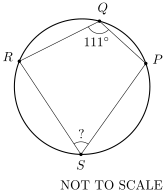
In the diagram, PQRSPQRS is a cyclic quadrilateral. Angle PQRPQR is 111∘111^\circ. Find the size of angle RSPRSP. (Diagram not to scale.)

Figure

Worked solution

Opposite angles of a cyclic quadrilateral add to 180∘180^\circ, so ∠RSP=180∘−111∘=69∘\angle RSP=180^\circ-111^\circ=69^\circ.

Answer

69∘69^\circ

Marking guidelines

Subtracts the opposite angle from a straight angle using the cyclic quadrilateral property

1 mark

Report a problem with this question.

Question 23 marksMedium

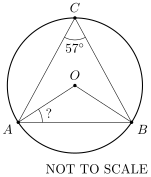
OO is the centre of a circle. The points AA, BB and CC lie on the circle, with CC on the major arc ABAB. Angle ACB=57∘ACB = 57^\circ. Find the size of angle OABOAB in degrees.

Figure

Worked solution

∠AOB=2×57=114∘\angle AOB = 2 \times 57 = 114^\circ (angle at the centre is twice the angle at the circumference)

OA=OBOA = OB (radii), so ∠OAB=180−1142\angle OAB = \dfrac{180 - 114}{2}

∠OAB=33∘\angle OAB = 33^\circ

Answer

33∘33^\circ

Marking guidelines

Uses the angle at the centre theorem to find the angle at the centre

1 mark

Recognises the isosceles triangle formed by two radii

1 mark

Finds the base angle

1 mark

Report a problem with this question.

Not affiliated with NESA.