
Year 10 Mathematics

Probability notation, mutually exclusive events and conditional probability

Two worked questions, each with its solution and marking guidelines.

  • Questions at easy and medium levels
  • As short answer and multiple choice
  • Some with diagrams
  • New numbers every time, from 5,000+ templates across NSW Years 7 to 12

Two worked examples

Question 12 marksEasier

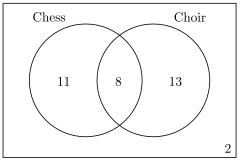
Out of 34 students surveyed, 19 enjoy Chess, 21 enjoy Choir, and 8 enjoy both activities, as the Venn diagram shows. One student is chosen at random from this group. Given that this student enjoys Chess, determine the probability that the same student also enjoys Choir, expressing your answer as a fraction in simplest form.
Figure

Worked solution

Only Chess: 19−8=1119-8=11 students. Only Choir: 21−8=1321-8=13 students. Neither activity: 34−(11+8+13)=234-(11+ 8+ 13)= 2 students.

The conditional probability is P(Choir∣Chess)=P(Chess∩Choir)P(Chess)=819P(\text{Choir}\mid\text{Chess})=\dfrac{P(\text{Chess}\cap\text{Choir})}{P(\text{Chess})}= \dfrac{8}{19}.

Answer

819\dfrac{8}{19}

Marking guidelines

Determines how many students fall into each of the only-Chess, only-Choir, and neither-activity categories

1 mark

Calculates the correct conditional probability in fully simplified form

1 mark

Report a problem with this question.

Question 23 marksMedium

A gym has 143143 members. Of these, 100100 use the pool, 8989 use the sauna and 1919 use neither the pool nor the sauna. A member who uses the pool is chosen at random. Find the probability that this member does not use the sauna, giving your answer as a fraction in lowest terms.

Worked solution

n(pool∪sauna)=143−19=124n(\text{pool} \cup \text{sauna}) = 143 - 19 = 124

n(both)=100+89−124=65n(\text{both}) = 100 + 89 - 124 = 65

n(pool only)=100−65=35n(\text{pool only}) = 100 - 65 = 35

P(no sauna∣pool)=35100=720P(\text{no sauna} \mid \text{pool}) = \dfrac{35}{100} = \dfrac{7}{20}

Answer

720\dfrac{7}{20}

Marking guidelines

Finds the number of members who use at least one facility

1 mark

Uses inclusion and exclusion to find the number who use both

1 mark

Divides the number who use the pool only by the number who use the pool and simplifies

1 mark

Report a problem with this question.

Not affiliated with NESA.