
Year 10 Mathematics

Limits of accuracy, measurement error and converting units

Two worked questions, each with its solution and marking guidelines.

  • Questions at easy and medium levels
  • As short answer and multiple choice
  • Some with diagrams
  • New numbers every time, from 5,000+ templates across NSW Years 7 to 12

Two worked examples

Question 12 marksMedium

The diagram shows a rod lying along a ruler marked in centimetres. The length of the rod is recorded as 6.26.2 cm, correct to the nearest division (the smallest part the scale is divided into). Find the upper bound of the actual length of the rod.
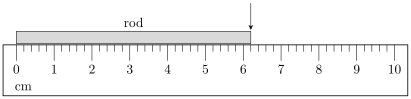
Figure

Worked solution

Each centimetre is divided into five equal parts, so the smallest division is 0.20.2 cm and half of it is 0.10.1 cm.

The upper bound is 6.2+0.1=6.36.2+0.1=6.3 cm.

Answer

6.36.3

Marking guidelines

Reads the smallest division of the scale from the diagram and halves it to find the maximum error

1 mark

Adds the maximum error to the recorded length

1 mark

Report a problem with this question.

Question 22 marksMedium

A rectangle has length 22.4 cm and width 12.8 cm. Each measurement is correct to the nearest millimetre. Find the least possible area of the rectangle, in square centimetres, correct to 2 decimal places.

Worked solution

Each measurement is correct to the nearest millimetre, so it is accurate to within 0.050.05 cm. The least possible length is 22.4−0.05=22.3522.4 - 0.05 = 22.35 cm.

The least possible width is 12.8−0.05=12.7512.8 - 0.05 = 12.75 cm.

The least possible area is 22.35×12.75=284.9625≈284.9622.35 \times 12.75 = 284.9625 \approx 284.96 cm2^2.

Answer

284.96284.96

Marking guidelines

Finds the least possible value of each measurement using the measurement error

1 mark

Multiplies the least possible values to find the least possible area to the required accuracy

1 mark

Report a problem with this question.

Not affiliated with NESA.