Year 11 Mathematics Advanced

Conditional probability

Two worked questions, each with its solution and marking guidelines. Tutors: get a whole lesson sheet on this topic, made for your student.

  • Questions at easy and medium levels
  • As short answer and multiple choice
  • Some with diagrams
  • New numbers every time, from 5,000+ templates across NSW Years 7 to 12
For tutors

Get a free lesson sheet

Made for your student, on any topic in Year 11 Mathematics Advanced, with worked solutions and a marking guide. By email, in under a minute.

  • Their name on their copy
  • Easy, medium or hard
  • No account needed
Get my free sheet

Two worked examples

Question 12 marksMedium

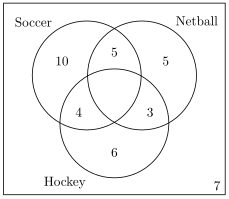
The Venn diagram shows the sports played by the students in a class, where every student is in exactly one region. The region for students who play all three sports is not labelled: 22 students play all three. In total, 1515 students in the class play netball. A student who plays netball is chosen at random. Find the probability that this student also plays hockey, correct to two decimal places.
Figure

Worked solution

Students who play netball and hockey: 3+2=53+ 2=5 (netball and hockey only, plus all three sports).

P=515≈0.33P=\dfrac{5}{15}\approx 0.33.

Answer

0.330.33

Marking guidelines

Finds the number of netball players who also play hockey, including those who play all three sports

1 mark

Divides by the number of netball players to find the probability and rounds correctly

1 mark

Report a problem with this question.

Question 23 marksMedium

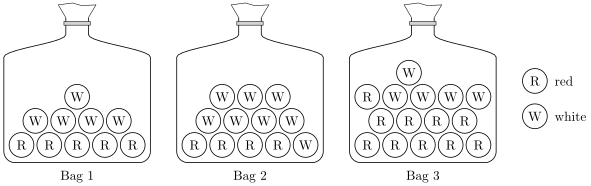
Bag 1, Bag 2 and Bag 3 are shown in the diagram, each marble being marked R (red) or W (white). Bag 3 holds 5 white marbles. A bag is chosen at random, each bag being equally likely, and one marble is taken from it. The marble is white. Find the probability that it came from Bag 3. Give your answer as a fraction in simplest form.

Figure

Worked solution

From the diagram, P(white∣Bag i)P(\text{white}\mid\text{Bag }i) for the three bags is 510\dfrac{5}{10}, 812\dfrac{8}{12} and 515\dfrac{5}{15}.

P(white)=13(510+812+515)=13×9060P(\text{white}) = \dfrac{1}{3}\left(\dfrac{5}{10}+\dfrac{8}{12}+\dfrac{5}{15}\right) = \dfrac{1}{3}\times\dfrac{90}{60} and P(white and Bag 3)=13×515P(\text{white and Bag 3}) = \dfrac{1}{3}\times\dfrac{5}{15}.

P(Bag 3∣white)=13×51513×9060=29P(\text{Bag 3}\mid\text{white}) = \dfrac{\frac{1}{3}\times \dfrac{5}{15}}{\frac{1}{3}\times\frac{90}{60}} = \dfrac{2}{ 9 }

Answer

29\dfrac{2}{ 9 }

Marking guidelines

Finds the probability of a white marble from each bag using the counts in the diagram

1 mark

Finds the total probability of a white marble and the probability of white and Bag 3 together

1 mark

Divides to find the conditional probability and simplifies

1 mark

Report a problem with this question.

Not affiliated with NESA.