Year 11 Mathematics Advanced

Reciprocal functions

Two worked questions, each with its solution and marking guidelines. Tutors: get a whole lesson sheet on this topic, made for your student.

  • Questions at easy and medium levels
  • As short answer and multiple choice
  • Some with diagrams
  • New numbers every time, from 5,000+ templates across NSW Years 7 to 12
For tutors

Get a free lesson sheet

Made for your student, on any topic in Year 11 Mathematics Advanced, with worked solutions and a marking guide. By email, in under a minute.

  • Their name on their copy
  • Easy, medium or hard
  • No account needed
Get my free sheet

Two worked examples

Question 12 marksMedium

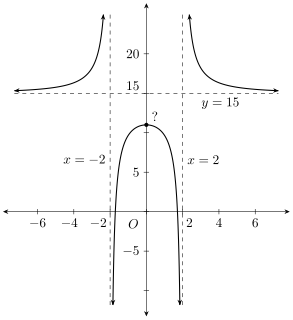
The diagram shows the graph of y=16(x+2)(x−2)+15y=\dfrac{ 16 }{(x+2)(x-2)}+15 with its asymptotes. The turning point of the middle branch is marked with a question mark. Find the yy-coordinate of this turning point.

Figure

Worked solution

The curve is symmetric about the yy-axis (the asymptotes are x=±2x=\pm2), so the turning point is at x=0x=0.

y=16(0+2)(0−2)+15=−164+15=11y=\dfrac{16}{(0+ 2)(0-2)}+ 15=-\dfrac{16}{4}+ 15=11.

Answer

1111

Marking guidelines

Locates the turning point on the axis of symmetry

1 mark

Substitutes to find the coordinate

1 mark

Report a problem with this question.

Question 22 marksMedium

The function f(x)=7−2x+3f(x) = 7 - \dfrac{ 2 }{ x + 3 } is defined for all real xx except one value. Find the value that is not in the range of ff.

Worked solution

The fraction 2x+3\dfrac{ 2 }{ x + 3 } is never equal to 00 for any xx in the domain.

So f(x)=7−2x+3f(x) = 7 - \dfrac{ 2 }{ x + 3 } is never equal to 77.

The value not in the range of ff is 77.

Answer

77

Marking guidelines

Identifies that the reciprocal term never takes the value zero

1 mark

States the value that the function never takes

1 mark

Report a problem with this question.

Not affiliated with NESA.