
Year 11 Mathematics Standard

Clusters and outliers

Two worked questions, each with its solution and marking guidelines. Tutors: get a whole lesson sheet on this topic, made for your student.

  • Questions at easy and medium levels
  • As short answer and multiple choice
  • Some with diagrams
  • New numbers every time, from 5,000+ templates across NSW Years 7 to 12
For tutors

Get a free lesson sheet

Made for your student, on any topic in Year 11 Mathematics Standard, with worked solutions and a marking guide. By email, in under a minute.

  • Their name on their copy
  • Easy, medium or hard
  • No account needed
Get my free sheet

Two worked examples

Question 12 marksMedium

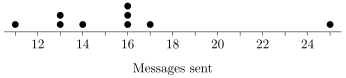
The dot plot shows the number of messages sent in one day by each of 9 people. The smallest number sent was 1111, and one person, who sent 2525 messages, is an outlier (a value that is far away from all the others). The outlier is removed. Find the median of the remaining values.
Figure

Worked solution

The outlier is 2525, far from the others. The remaining eight values in order are 11, 13, 13, 14, 16, 16, 16, 17.

The median is the mean of the fourth and fifth values: 14+162=15\dfrac{14+ 16}{2}=15 messages.

Answer

1515

Marking guidelines

Removes the outlier and lists the remaining values from the dot plot in order

1 mark

Finds the median of the remaining values by averaging the two middle values

1 mark

Report a problem with this question.

Question 23 marksMedium

The twelve values of a data set are shown below in order. 14, 17, 18, 26, 30, 32, 33, 34, 36, 46, 48, 7114,\ 17,\ 18,\ 26,\ 30,\ 32,\ 33,\ 34,\ 36,\ 46,\ 48,\ 71. Find the upper fence used to test whether the largest value is an outlier, where the quartiles are found by the median-of-halves method and an outlier lies more than one and a half interquartile ranges beyond a quartile.

Worked solution

The ordered values are 14,17,18,26,30,32,33,34,36,46,48,7114, 17, 18, 26, 30, 32, 33, 34, 36, 46, 48, 71.

Lower quartile: the mean of the 3rd and 4th values, 18+262=22\dfrac{18 + 26}{2} = 22.

Upper quartile: the mean of the 9th and 10th values, 36+462=41\dfrac{36 + 46}{2} = 41.

Interquartile range: 41−22=1941 - 22 = 19, and one and a half times it is 28.528.5.

Upper fence: 41+28.5=69.541 + 28.5 = 69.5.

Answer

69.569.5

Marking guidelines

Places the lower and upper halves and finds the middle pair of each

1 mark

Finds the lower and upper quartiles as the means of those middle pairs

1 mark

Finds the upper fence using one and a half interquartile ranges

1 mark

Report a problem with this question.

Not affiliated with NESA.