Year 11 Mathematics Standard

Practicalities of measurement

Two worked questions, each with its solution and marking guidelines. Tutors: get a whole lesson sheet on this topic, made for your student.

  • Questions at easy, medium and hard levels
  • As short answer and multiple choice
  • Some with diagrams
  • New numbers every time, from 5,000+ templates across NSW Years 7 to 12
For tutors

Get a free lesson sheet

Made for your student, on any topic in Year 11 Mathematics Standard, with worked solutions and a marking guide. By email, in under a minute.

  • Their name on their copy
  • Easy, medium or hard
  • No account needed
Get my free sheet

Two worked examples

Question 12 marksMedium

A kitchen scale measures mass to the nearest 2020 g. A parcel is weighed on this scale and its mass is recorded as 360360 g. Find the greatest possible percentage error in this measurement, correct to 2 decimal places.

Worked solution

Absolute error=202=10\text{Absolute error} = \frac{20}{2} = 10 g

Percentage error=10360×100≈2.78%\text{Percentage error} = \frac{10}{360} \times 100 \approx 2.78\%

Answer

2.78%2.78\%

Marking guidelines

Finds the absolute error as half of the smallest unit of the scale

1 mark

Divides the absolute error by the recorded mass and multiplies by one hundred, rounding as required

1 mark

Report a problem with this question.

Question 24 marksMedium

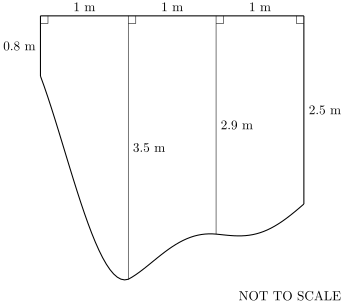
The uniform cross-section of a 30 metre long ornamental pond is shown in the diagram (not to scale). The width across the top is divided into three equal strips, each 11 m wide, and the vertical depths at the four dividing lines, in order across the pond, are 0.80.8 m, 3.53.5 m, 2.92.9 m and 2.52.5 m. Use three applications of the trapezoidal rule to determine the approximate capacity of the pond, in litres.

Figure

Worked solution

The strip width is h=1h = 1 m, so A≈12[(0.8+3.5)+(3.5+2.9)+(2.9+2.5)]A \approx \dfrac{1}{2}\left[(0.8 + 3.5) + (3.5 + 2.9) + (2.9 + 2.5)\right].

A≈12×(4.3+6.4+5.4)=8.05A \approx \dfrac{1}{2} \times (4.3 + 6.4 + 5.4) = 8.05 square metres.

Volume =8.05×30=241.5= 8.05 \times 30 = 241.5 cubic metres.

Capacity =241.5×1000=241500= 241.5 \times 1000 = 241500 litres.

Answer

241500241500

Marking guidelines

Sets up three applications of the trapezoidal rule using the strip width and the depths

1 mark

Correct cross-sectional area

1 mark

Correct volume in cubic metres

1 mark

Correct capacity in litres

1 mark

Report a problem with this question.

Not affiliated with NESA.