Year 12 Mathematics Advanced

Geometric sequences and series

Two worked questions, each with its solution and marking guidelines. Tutors: get a whole lesson sheet on this topic, made for your student.

  • Questions at easy and medium levels
  • As short answer and multiple choice
  • Some with diagrams
  • New numbers every time, from 5,000+ templates across NSW Years 7 to 12
For tutors

Get a free lesson sheet

Made for your student, on any topic in Year 12 Mathematics Advanced, with worked solutions and a marking guide. By email, in under a minute.

  • Their name on their copy
  • Easy, medium or hard
  • No account needed
Get my free sheet

Two worked examples

Question 12 marksEasier

The geometric series 5−15+45+⋯5- 15+ 45 + \cdots continues with the same common ratio. Find the sum of its first 6 terms.

Worked solution

The common ratio is r=−155=−3r = \dfrac{-15}{5} = -3.

S6=5(1−(−3)6)1−(−3)=−910S_6 = \dfrac{5(1-(-3)^6)}{1-(-3)} = -910.

Answer

−910-910

Marking guidelines

Finds the common ratio from the first two terms

1 mark

Substitutes into the sum formula for six terms and evaluates the total

1 mark

Report a problem with this question.

Question 23 marksMedium

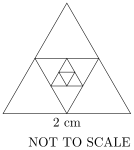
The diagram shows the start of a pattern of equilateral triangles. The largest triangle has side 22 cm, and each other triangle is drawn by joining the midpoints of the sides of the triangle before it. The pattern continues without end. Find the sum of the perimeters of all the triangles.

Figure

Worked solution

The largest triangle has perimeter 3×2=63\times2=6 cm.

Each triangle has half the side of the one before, so the perimeters have common ratio 12\dfrac{1}{2}.

The sum of all the perimeters is 61−12=12\dfrac{6}{1-\frac{1}{2}}=12 cm.

Answer

1212

Marking guidelines

Finds the perimeter of the largest triangle

1 mark

Finds the common ratio of the successive perimeters

1 mark

Uses the sum to infinity to find the total of the perimeters

1 mark

Report a problem with this question.

Not affiliated with NESA.