Year 12 Mathematics Advanced

Modelling with functions

Two worked questions, each with its solution and marking guidelines. Tutors: get a whole lesson sheet on this topic, made for your student.

  • Questions at easy and medium levels
  • As short answer and multiple choice
  • Some with diagrams
  • New numbers every time, from 5,000+ templates across NSW Years 7 to 12
For tutors

Get a free lesson sheet

Made for your student, on any topic in Year 12 Mathematics Advanced, with worked solutions and a marking guide. By email, in under a minute.

  • Their name on their copy
  • Easy, medium or hard
  • No account needed
Get my free sheet

Two worked examples

Question 12 marksEasier

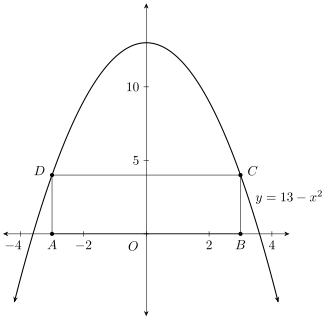
The diagram shows the parabola y=13−x2y=13-x^2 and a rectangle ABCDABCD with AA and BB on the xx-axis and CC and DD on the parabola. The rectangle extends 33 units to each side of the yy-axis. Find the area of rectangle ABCDABCD.

Figure

Worked solution

The height of the rectangle is y=13−32=4y=13-3^2=4.

Area =2×3×4=24=2\times3\times4=24 square units.

Answer

2424

Marking guidelines

Finds the height of the rectangle from the parabola

1 mark

Multiplies the width by the height

1 mark

Report a problem with this question.

Question 23 marksMedium

The volume VV of froth on a freshly poured drink decays exponentially, so that V=V0e−ktV = V_0 e^{-kt}, where tt is the time in minutes after pouring and kk is a positive constant. The froth volume halves every 1212 minutes. Find the time, in minutes, for the froth volume to fall to 62%62\% of its initial volume. Give your answer correct to 2 decimal places.

Worked solution

At the half-life, V0e−12k=12V0V_0 e^{-12k} = \dfrac{1}{2}V_0, so e−12k=12e^{-12k} = \dfrac{1}{2} and k=ln⁡212≈0.05776k = \dfrac{\ln 2}{12} \approx 0.05776.

The target is 62%62\% of the initial volume, so e−kt=62100=0.62e^{-kt} = \dfrac{62}{100} = 0.62.

Taking natural logarithms, t=ln⁡(10062)k=12ln⁡(10062)ln⁡2≈8.2759t = \dfrac{\ln\left(\frac{100}{62}\right)}{k} = \dfrac{12\ln\left(\frac{100}{62}\right)}{\ln 2} \approx 8.2759.

So the froth reaches 62%62\% of its initial volume after 8.288.28 minutes, to 2 decimal places.

Answer

8.288.28

Marking guidelines

Uses the half-life to find the decay constant

1 mark

Converts the percentage to a fraction and sets up the equation for the time

1 mark

Solves using natural logarithms and rounds correctly

1 mark

Report a problem with this question.

Not affiliated with NESA.