
Question 12 marksEasier
Evaluate .
Worked solution
.
.
Answer
Marking guidelines
Correct antiderivative | 1 mark |
Correct value (limits substituted in the right order) | 1 mark |
Report a problem with this question.
Two worked questions, each with its solution and marking guidelines. Tutors: get a whole lesson sheet on this topic, made for your student.
Made for your student, on any topic in Year 12 Mathematics Advanced, with worked solutions and a marking guide. By email, in under a minute.
Evaluate .
.
.
Correct antiderivative | 1 mark |
Correct value (limits substituted in the right order) | 1 mark |
Report a problem with this question.
A particle moves in a straight line with velocity metres per second at time seconds. The diagram shows the graph, with the area under it shaded between and . Find the particle's average velocity over that time interval. Give your answer correct to 2 decimal places.
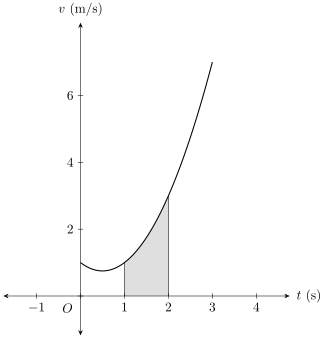
.
m.
Average velocity m/s.
Finds an antiderivative of the velocity | 1 mark |
Evaluates it between the two limits to find the displacement | 1 mark |
Divides by the length of the time interval | 1 mark |
Report a problem with this question.
Not affiliated with NESA.