
Year 12 Mathematics Extension 1

Binomial distributions

Two worked questions, each with its solution and marking guidelines. Tutors: get a whole lesson sheet on this topic, made for your student.

  • Questions at easy and medium levels
  • As short answer and multiple choice
  • Some with diagrams
  • New numbers every time, from 5,000+ templates across NSW Years 7 to 12
For tutors

Get a free lesson sheet

Made for your student, on any topic in Year 12 Mathematics Extension 1, with worked solutions and a marking guide. By email, in under a minute.

  • Their name on their copy
  • Easy, medium or hard
  • No account needed
Get my free sheet

Two worked examples

Question 12 marksMedium

A biased coin lands heads with probability 0.620.62 on each toss. It is tossed three times, as shown in the tree diagram. Find the probability of exactly two heads. Give your answer correct to 2 decimal places.
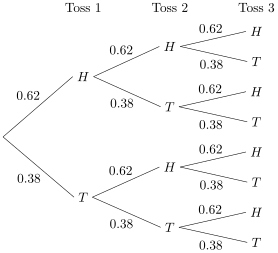
Figure

Worked solution

Each of the three paths with two heads and one tail has probability 0.62×0.62×0.38≈0.1460.62\times0.62\times0.38\approx0.146.

P(exactly two heads)≈3×0.146=0.438216≈0.44P(\text{exactly two heads})\approx3\times0.146=0.438216 \approx 0.44.

Answer

0.440.44

Marking guidelines

Finds the probability of one path with two heads and one tail

1 mark

Multiplies by the number of such paths

1 mark

Report a problem with this question.

Question 24 marksMedium

A cafe buys muffins from two bakeries, Bakery A and Bakery B, in the ratio 6 : 7. A muffin from Bakery A is burnt with probability 5% and a muffin from Bakery B is burnt with probability 7%. A tray holds 15 muffins, and each muffin on it independently comes from the two bakeries in that ratio. Find the probability that at most two muffins on the tray are burnt. Give your answer correct to 3 significant figures.

Worked solution

The overall probability that a muffin is burnt is p=6×5+7×713×100≈0.061p=\dfrac{6\times5+ 7\times7}{13\times100}\approx0.061.

With X∼B(15,0.061)X\sim B(15,0.061), P(X≤2)=P(X=0)+P(X=1)+P(X=2)P(X\le 2)=P(X=0)+P(X=1)+P(X=2), where P(X=0)≈0.39047P(X=0)\approx0.39047, P(X=1)≈0.37895P(X=1)\approx0.37895 and P(X=2)≈0.17163P(X=2)\approx0.17163.

P(X≤2)≈0.94105≈0.941P(X\le 2)\approx0.94105\approx0.941

Answer

0.9410.941

Marking guidelines

Finds the overall probability that a muffin is burnt as a weighted average using the ratio

1 mark

Models the number of burnt muffins on a tray as a binomial random variable with the correct parameters

1 mark

Finds the probabilities of none, one and two burnt muffins

1 mark

Adds them and rounds to the stated accuracy

1 mark

Report a problem with this question.

Not affiliated with NESA.