
Year 12 Mathematics Extension 1

Further rates of change

Two worked questions, each with its solution and marking guidelines. Tutors: get a whole lesson sheet on this topic, made for your student.

  • Questions at easy and medium levels
  • As short answer and multiple choice
  • Some with diagrams
  • New numbers every time, from 5,000+ templates across NSW Years 7 to 12
For tutors

Get a free lesson sheet

Made for your student, on any topic in Year 12 Mathematics Extension 1, with worked solutions and a marking guide. By email, in under a minute.

  • Their name on their copy
  • Easy, medium or hard
  • No account needed
Get my free sheet

Two worked examples

Question 13 marksMedium

A balloon rises vertically at a constant 1313 m/s. An observer on level ground stands 6161 m from the point directly below the balloon, and θ\theta is the angle of elevation of the balloon from the observer, as in the diagram. Find the rate at which θ\theta is increasing at the instant the balloon is 9090 m above the ground. Give the answer in radians per second, correct to four decimal places. (Diagram not to scale.)
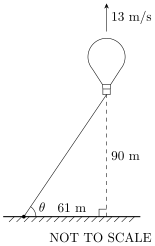
Figure

Worked solution

With d=61d=61 constant, tan⁡θ=h61\tan\theta=\dfrac{h}{61}. Differentiating with respect to tt: sec⁡2θ dθdt=161×dhdt\sec^2\theta\,\dfrac{d\theta}{dt}=\dfrac{1}{61}\times\dfrac{dh}{dt}.

sec⁡2θ=1+h2612=1+902612\sec^2\theta=1+\dfrac{h^2}{61^2}=1+\dfrac{90^2}{61^2}, so dθdt=61612+902×dhdt\dfrac{d\theta}{dt}=\dfrac{61}{61^2+ 90^2}\times\dfrac{dh}{dt}.

dθdt=61×13612+902≈0.06708\dfrac{d\theta}{dt}=\dfrac{61\times 13}{61^2+90^2}\approx 0.06708, which is 0.06710.0671 rad/s to four decimal places.

Answer

0.06710.0671

Marking guidelines

Relates the angle to the height and the fixed horizontal distance using the tangent

1 mark

Differentiates with respect to time using the chain rule

1 mark

Substitutes the height and the rate of rise to find the rate of change of the angle

1 mark

Report a problem with this question.

Question 23 marksEasier

A spherical balloon is inflated so that its radius increases at a constant rate of 4.5 cm/s. The volume of a sphere of radius rr is V=43πr3V = \frac{4}{3}\pi r^3. Find the exact rate, in cm3^3/s, at which the volume is increasing when the radius is 20 cm.

Worked solution

dVdr=4πr2\frac{dV}{dr} = 4\pi r^2

dVdt=dVdr×drdt=4π(20)2×4.5\frac{dV}{dt} = \frac{dV}{dr} \times \frac{dr}{dt} = 4\pi(20)^2 \times 4.5

dVdt=7200π\frac{dV}{dt} = 7200\pi

Answer

7200π7200\pi

Marking guidelines

Differentiates the volume formula with respect to the radius

1 mark

Applies the chain rule to connect the rates of change

1 mark

Substitutes the given values to find the exact rate

1 mark

Report a problem with this question.

Not affiliated with NESA.