
Year 12 Mathematics Extension 1

Projectile motion

Two worked questions, each with its solution and marking guidelines. Tutors: get a whole lesson sheet on this topic, made for your student.

  • Questions at easy, medium and hard levels
  • As short answer and multiple choice
  • Some with diagrams
  • New numbers every time, from 5,000+ templates across NSW Years 7 to 12
For tutors

Get a free lesson sheet

Made for your student, on any topic in Year 12 Mathematics Extension 1, with worked solutions and a marking guide. By email, in under a minute.

  • Their name on their copy
  • Easy, medium or hard
  • No account needed
Get my free sheet

Two worked examples

Question 12 marksEasier

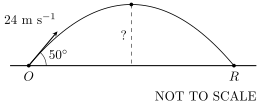
In the diagram, a ball is projected from OO with a speed of 24 m s−124\text{ m s}^{-1} at an angle of 50∘50^\circ above the horizontal. Its path reaches a greatest height, marked on the diagram, before it lands at RR on the same level as OO. Find the greatest height of the ball above OO, correct to 2 decimal places. Take g=10 m s−2g=10\text{ m s}^{-2} and ignore air resistance. (Diagram not to scale.)
Figure

Worked solution

Initial vertical speed: Vsin⁡θ=24sin⁡50∘≈18.39 m s−1V\sin\theta=24\sin 50^\circ\approx 18.39\text{ m s}^{-1}.

At the greatest height the vertical speed is zero, so 0≈18.392−2(10)H0\approx18.39^2-2(10)H and H≈16.90 mH\approx 16.90\text{ m}.

Answer

16.9016.90

Marking guidelines

Finds the initial vertical component of the velocity

1 mark

Uses the zero vertical speed at the top to find the greatest height

1 mark

Report a problem with this question.

Question 23 marksMedium

A ball is struck from level ground. At time tt seconds after it is struck, its horizontal distance is x=14tx = 14t metres and its height is y=30t−4.9t2y = 30t - 4.9t^2 metres. Find the horizontal distance of the ball when it is at a height of 12 metres on its way down. Give your answer in metres, correct to 1 decimal place.

Worked solution

Set y=12y = 12: 4.9t2−30t+12=04.9t^2 - 30t + 12 = 0.

t=30±302−19.6(12)9.8=30±664.89.8t = \dfrac{30 \pm \sqrt{30^2 - 19.6(12)}}{9.8} = \dfrac{30 \pm \sqrt{664.8}}{9.8}; the descent is the later time t≈5.6922…t \approx 5.6922\ldots s.

x=14t≈14×5.6922…≈79.691…≈79.7x = 14t \approx 14 \times 5.6922\ldots \approx 79.691\ldots \approx 79.7 m

Answer

79.779.7

Marking guidelines

Sets the vertical position equal to the target height and forms the quadratic in time

1 mark

Solves the quadratic and selects the later time for the descent

1 mark

Substitutes into the horizontal position and rounds to one decimal place

1 mark

Report a problem with this question.

Not affiliated with NESA.