Year 12 Mathematics Extension 2

Geometric representation of complex numbers

Two worked questions, each with its solution and marking guidelines.

  • Questions at easy, medium and hard levels
  • As short answer and multiple choice
  • Some with diagrams
  • New numbers every time, from 5,000+ templates across NSW Years 7 to 12

Two worked examples

Question 12 marksEasier

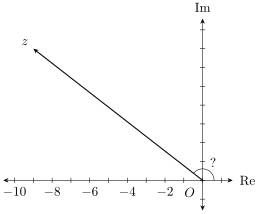
The diagram shows the complex number z=−9+7iz = -9+ 7i on an Argand diagram. Find the argument of zz in degrees, taking the principal value from −180∘-180^\circ to 180∘180^\circ, correct to the nearest degree.

Figure

Worked solution

The acute angle between the arrow and the negative real axis is tan⁡−179≈37.87∘\tan^{-1}\dfrac{7}{9} \approx 37.87^\circ.

The point is in the second quadrant, so arg⁡z≈180∘−37.87∘≈142∘\arg z \approx 180^\circ - 37.87^\circ \approx 142^\circ.

Answer

142142

Marking guidelines

Finds the acute reference angle from the inverse tangent of the ratio of the parts

1 mark

Subtracts it from a straight angle because the point is in the second quadrant and rounds correctly

1 mark

Report a problem with this question.

Question 23 marksMedium

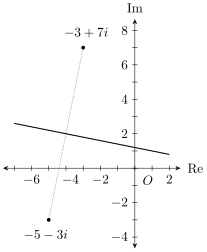
The diagram shows the points representing z1=−5−3iz_1 = -5- 3i and z2=−3+7iz_2 = -3+ 7i on an Argand diagram, together with the line of all points zz for which ∣z−z1∣=∣z−z2∣|z - z_1| = |z - z_2|. This line meets the imaginary axis at the point iyiy. Find yy.

Figure

Worked solution

The point iyiy lies on the line, so ∣iy−z1∣2=∣iy−z2∣2|iy - z_1|^2 = |iy - z_2|^2, that is (−5)2+(y+3)2=(−3)2+(y−7)2(-5)^2 + (y+ 3)^2 = (-3)^2 + (y- 7)^2.

Expanding, the y2y^2 terms cancel, leaving 2(7+3)y=(−3)2+72−(−5)2−(−3)22(7+ 3)y = (-3)^2 + 7^2 - (-5)^2 - (-3)^2.

So 20y=2420y = 24, giving y=1.2y = 1.2.

Answer

1.21.2

Marking guidelines

Writes the condition that the point on the imaginary axis is equidistant from the two points

1 mark

Expands both sides and cancels the squared terms to form a linear equation

1 mark

Solves for the imaginary-axis coordinate

1 mark

Report a problem with this question.

Not affiliated with NESA.