
Year 12 Mathematics Extension 2

Simple harmonic motion

Two worked questions, each with its solution and marking guidelines.

  • Questions at easy, medium and hard levels
  • As short answer and multiple choice
  • Some with diagrams
  • New numbers every time, from 5,000+ templates across NSW Years 7 to 12

Two worked examples

Question 12 marksEasier

A particle moves in simple harmonic motion with displacement x=acos⁡(nt+α)x=a\cos(nt+\alpha) metres at time tt seconds. The diagram shows its displacement-time graph, with the amplitude of 55 m and the period of 2020 s marked. Find the maximum speed of the particle, correct to 2 decimal places.
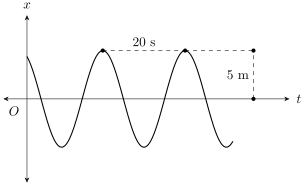
Figure

Worked solution

The period is 2020 s, so n=2π20≈0.3142n=\dfrac{2\pi}{20}\approx 0.3142 rad/s.

Maximum speed =an≈5×0.3142≈1.57=an\approx5\times 0.3142\approx 1.57 m/s.

Answer

1.571.57

Marking guidelines

Uses the period to find the angular frequency

1 mark

Multiplies the amplitude by the angular frequency to find the maximum speed, to the required accuracy

1 mark

Report a problem with this question.

Question 23 marksEasier

A particle moves in simple harmonic motion on a straight line with acceleration x¨=−22(x−2)\ddot{x} = -2^2(x - 2), where xx metres is its displacement from a fixed point OO. When x=3x = 3 its speed is 55 m/s.

Find the amplitude of the motion, in metres, correct to 2 decimal places.

Worked solution

The centre is x=2x = 2 and v2=22(a2−(x−2)2)v^2 = 2^2\left(a^2 - (x - 2)^2\right)

52=22(a2−(3−2)2)5^2 = 2^2\left(a^2 - (3 - 2)^2\right), so a2=(3−2)2+5222a^2 = (3 - 2)^2 + \dfrac{5^2}{2^2}

a=(3−2)2+5222≈2.69a = \sqrt{(3 - 2)^2 + \dfrac{5^2}{2^2}} \approx 2.69

Answer

2.692.69

Marking guidelines

Identifies the centre of motion and writes the speed relation about that centre

1 mark

Substitutes the given position and speed and solves for the square of the amplitude

1 mark

Takes the square root to find the amplitude

1 mark

Report a problem with this question.

Not affiliated with NESA.