
Year 12 Mathematics Standard 1

Relative frequency and probability

Two worked questions, each with its solution and marking guidelines.

  • Questions at easy and medium levels
  • As short answer and multiple choice
  • Some with diagrams
  • New numbers every time, from 5,000+ templates across NSW Years 7 to 12

Two worked examples

Question 12 marksMedium

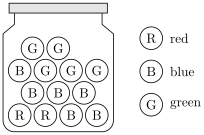
The diagram shows a jar holding 2 red marbles (marked R) and marbles of two other colours (marked B and G). A marble is taken out at random, its colour is noted and it is put back. This is repeated 78 times. How many times would you expect the marble taken out not to be red?
Figure

Worked solution

From the diagram there are 22 red, 66 blue and 55 green marbles, 1313 in all, so P(not red)=1113P(\text{not red}) = \dfrac{11}{13}.

Expected number =78×1113=66= 78\times\dfrac{11}{13} = 66.

Answer

6666

Marking guidelines

Counts the marbles of each kind from the diagram and finds the probability of a marble that is not red

1 mark

Multiplies the probability by the number of repeats to find the expected number

1 mark

Report a problem with this question.

Question 23 marksMedium

A survey of some shoppers recorded which department of a store they visited first.

DepartmentGroceryElectronicsClothingOtherFrequency2594112\begin{array}{c|cccc} \text{Department} & \text{Grocery} & \text{Electronics} & \text{Clothing} & \text{Other} \\ \hline \text{Frequency} & 25 & 9 & 41 & 12 \end{array}

Based on these results, how many of the next 480 shoppers would you expect to visit the Electronics department first? Give your answer correct to the nearest whole number.

Worked solution

n=25+9+41+12=87n = 25 + 9 + 41 + 12 = 87

Relative frequency=987=329\text{Relative frequency} = \dfrac{9}{87} = \dfrac{3}{29}

Expected number=987×480≈50\text{Expected number} = \dfrac{9}{87} \times 480 \approx 50

Answer

5050

Marking guidelines

Finds the total number of shoppers surveyed

1 mark

Finds the relative frequency of the stated department

1 mark

Multiplies the relative frequency by the further number of trials and rounds to the nearest whole number

1 mark

Report a problem with this question.

Not affiliated with NESA.