Year 12 Mathematics Standard 2

Critical path analysis

Two worked questions, each with its solution and marking guidelines. Tutors: get a whole lesson sheet on this topic, made for your student.

  • Questions at easy and medium levels
  • As short answer and multiple choice
  • Some with diagrams
  • New numbers every time, from 5,000+ templates across NSW Years 7 to 12
For tutors

Get a free lesson sheet

Made for your student, on any topic in Year 12 Mathematics Standard 2, with worked solutions and a marking guide. By email, in under a minute.

  • Their name on their copy
  • Easy, medium or hard
  • No account needed
Get my free sheet

Two worked examples

Question 13 marksMedium

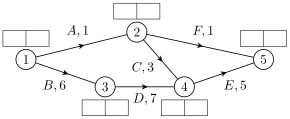
The diagram shows the activity network for a project, with the times of the activities in days and an empty scanning box at each event. Activity AA takes 11 day and activity FF takes 11 day. Find the float time of activity FF, in days.

Figure

Worked solution

Forward pass: the earliest time at event 4 is the larger of 1+31+3 and 6+7=136+7=13, which is 1313 days.

The earliest time at event 5 is the larger of 13+5=1813+5=18 and 1+11+ 1, so the minimum completion time is 1818 days.

Float of F=18−1−1=16F=18-1-1=16 days.

Answer

1616

Marking guidelines

Carries out the forward pass to find the earliest time at the event where C and D meet

1 mark

Finds the earliest time at the final event, which is the minimum completion time

1 mark

Subtracts the earliest start and the duration of F from the latest finish to find the float

1 mark

Report a problem with this question.

Question 22 marksMedium

A small building project has seven activities. The table shows the duration of each activity and its immediate predecessors.

ActivityDuration (days)Immediate predecessorsA5noneB2noneC6AD8AE3BF7C,EG4D,F\begin{array}{|c|c|c|} \hline \text{Activity} & \text{Duration (days)} & \text{Immediate predecessors} \\ \hline A & 5 & \text{none} \\ \hline B & 2 & \text{none} \\ \hline C & 6 & A \\ \hline D & 8 & A \\ \hline E & 3 & B \\ \hline F & 7 & C, E \\ \hline G & 4 & D, F \\ \hline \end{array}

Find the minimum completion time of the project, in days.

Worked solution

Path A→C→F→GA \to C \to F \to G: 5+6+7+4=225 + 6 + 7 + 4 = 22; path A→D→GA \to D \to G: 5+8+4=175 + 8 + 4 = 17; path B→E→F→GB \to E \to F \to G: 2+3+7+4=162 + 3 + 7 + 4 = 16

The longest path is A→C→F→GA \to C \to F \to G, so the minimum completion time is 2222 days

Answer

2222

Marking guidelines

Finds the total duration of each path through the project

1 mark

Identifies the longest path and states its length as the minimum completion time

1 mark

Report a problem with this question.

Not affiliated with NESA.