Year 7 Mathematics

Area of rectangles, triangles and parallelograms, and units of area

Two worked questions, each with its solution and marking guidelines.

  • Questions at easy and medium levels
  • As short answer
  • Some with diagrams
  • New numbers every time, from 5,000+ templates across NSW Years 7 to 12

Two worked examples

Question 11 markEasier

A parallelogram has a base of 16 cm16\text{ cm} and a perpendicular height of 11 cm11\text{ cm}, as shown. Find its area, in square centimetres.
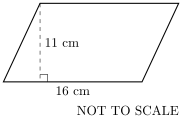
Figure

Worked solution

Area of a parallelogram == base ×\times perpendicular height.

A=16×11=176 cm2A = 16 \times 11 = 176\text{ cm}^{2}.

Answer

176 cm2176\text{ cm}^{2}

Marking guidelines

Multiplies the base by the perpendicular height

1 mark

Report a problem with this question.

Question 23 marksMedium

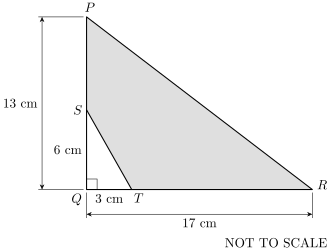
In the diagram, PQRPQR is a right-angled triangle with the right angle at QQ. QP=13 cmQP = 13\text{ cm} and QR=17 cmQR = 17\text{ cm}. The point SS is on QPQP with QS=6 cmQS = 6\text{ cm}, and the point TT is on QRQR with QT=3 cmQT = 3\text{ cm}. Triangle QSTQST is cut out. Find the area of the shaded region that is left, in square centimetres.

Figure

Worked solution

Area of triangle PQR=12×13×17=110.5 cm2PQR = \dfrac{1}{2} \times 13 \times 17 = 110.5\text{ cm}^{2}.

Area of triangle QST=12×6×3=9 cm2QST = \dfrac{1}{2} \times 6 \times 3 = 9\text{ cm}^{2}.

Shaded area =110.5−9=101.5 cm2= 110.5 - 9 = 101.5\text{ cm}^{2}.

Answer

101.5 cm2101.5\text{ cm}^{2}

Marking guidelines

Finds the area of the large triangle

1 mark

Finds the area of the cut-out triangle

1 mark

Subtracts the small area from the large area

1 mark

Report a problem with this question.

Not affiliated with NESA.