
Year 8 Mathematics

Expanding and simplifying, and factorising by the highest common factor

Two worked questions, each with its solution and marking guidelines.

  • Questions at easy and medium levels
  • As short answer and multiple choice
  • Some with diagrams
  • New numbers every time, from 5,000+ templates across NSW Years 7 to 12

Two worked examples

Question 11 markEasier

The diagram shows rectangle ABCDABCD, where AD=hAD = h metres, AP=14AP = 14 metres and PB=kPB = k metres. Write an expression for the area of the rectangle, in square metres.
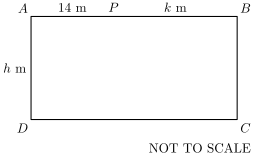
Figure

Worked solution

AB=AP+PB=14+kAB = AP + PB = 14 + k metres

Area=AD×AB=h(14+k)=14h+hk\text{Area} = AD \times AB = h(14 + k) = 14h + hk

Answer

h(14+k)h\left(14+k\right)

Marking guidelines

Adds the two segments to find the full top side and multiplies by the other side to give the area

1 mark

Report a problem with this question.

Question 21 markMedium

Write the expression that goes inside the brackets so that j()=2jk+5j2j\left( \quad \right) = 2jk + 5j^2.

Worked solution

Divide each term by jj.

2jk÷j=2k2jk \div j = 2k and 5j2÷j=5j5j^{2} \div j = 5j

The expression in the brackets is 2k+5j2k + 5j.

Answer

2k+5j2k + 5j

Marking guidelines

Divides each term of the expanded form by the common monomial to find both terms in the brackets

1 mark

Report a problem with this question.

Not affiliated with NESA.