Year 8 Mathematics

Angles on parallel lines, including unknowns written as expressions

Two worked questions, each with its solution and marking guidelines.

  • Questions at easy, medium and hard levels
  • As short answer and multiple choice
  • Some with diagrams
  • New numbers every time, from 5,000+ templates across NSW Years 7 to 12

Two worked examples

Question 13 marksEasier

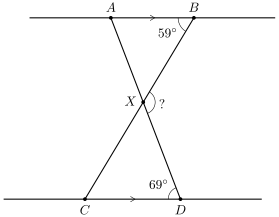
In the diagram, AB∥CDAB \parallel CD, and ADAD and BCBC cross at XX. Angle ADCADC is 69∘69^\circ and angle ABCABC is 59∘59^\circ. Find the size of angle BXDBXD, in degrees.

Figure

Worked solution

Angles BADBAD and ADCADC are alternate angles between parallel lines, so ∠BAD=69∘\angle BAD = 69^\circ.

The angles in triangle ABXABX add to 180∘180^\circ, so ∠AXB=180−69−59=52∘\angle AXB = 180 - 69 - 59 = 52^\circ.

Angles AXBAXB and BXDBXD lie on the straight line ADAD, so ∠BXD=180−52=128∘\angle BXD = 180 - 52 = 128^\circ.

Answer

128∘128^\circ

Marking guidelines

Uses alternate angles between the parallel lines to find an angle of the triangle

1 mark

Uses the angle sum of a triangle to find the angle at the crossing point

1 mark

Uses angles on a straight line to give the required angle

1 mark

Report a problem with this question.

Question 21 markEasier

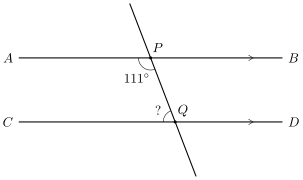
The diagram shows parallel lines ABAB and CDCD. A transversal PQPQ crosses ABAB at PP and CDCD at QQ, with AA and CC on the same side of PQPQ. Angle APQAPQ is 111∘111^\circ. What is the size of angle PQCPQC?

Figure

Worked solution

Angles APQAPQ and PQCPQC are co-interior angles: they lie between the parallel lines on the same side of the transversal.

Co-interior angles add to a straight angle, so PQC=180∘−111∘=69∘PQC = 180^\circ - 111^\circ = 69^\circ.

Answer

69∘69^\circ

Marking guidelines

Recognises the angles are co-interior and finds the missing angle using a straight angle

1 mark

Report a problem with this question.

Not affiliated with NESA.