Year 9 Mathematics

Area, and surface area of prisms and cylinders

Two worked questions, each with its solution and marking guidelines.

  • Questions at easy, medium and hard levels
  • As short answer and multiple choice
  • Some with diagrams
  • New numbers every time, from 5,000+ templates across NSW Years 7 to 12

Two worked examples

Question 12 marksEasier

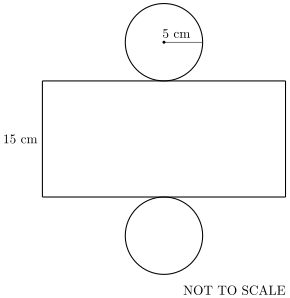
The diagram shows the net of a closed cylinder. Each circle has radius 5 cm5\text{ cm} and the cylinder has height 15 cm15\text{ cm}. Find the total surface area of the cylinder, correct to 1 decimal place.
Figure

Worked solution

Curved surface (the rectangle): 2π(5)(15)=150π2\pi(5)(15)=150\pi. Two circular ends: 2×π(5)2=50π2\times\pi(5)^2=50\pi.

Total surface area =150π+50π=200π≈628.3 cm2=150\pi+ 50\pi=200\pi\approx 628.3\text{ cm}^2.

Answer

628.3628.3

Marking guidelines

Finds the area of the curved surface (the rectangle) and the area of the two circular ends

1 mark

Adds the areas to find the total surface area

1 mark

Report a problem with this question.

Question 23 marksMedium

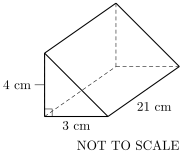
The diagram shows a prism whose triangular ends are right-angled triangles. The two shorter sides of each triangular end, which are perpendicular, are 3 cm3\text{ cm} and 4 cm4\text{ cm}, and the prism is 21 cm21\text{ cm} long. Find the total surface area of the prism. (Diagram not to scale.)

Figure

Worked solution

Longest side of each end: 32+42=5 cm\sqrt{3^2+ 4^2}=5\text{ cm}.

The two ends have total area 2×12×3×4=12 cm22\times\tfrac{1}{2}\times3\times4=12\text{ cm}^2. The three rectangular faces have total area 21×(3+4+5)=252 cm221\times(3+ 4+ 5)=252\text{ cm}^2.

Total surface area =12+252=264 cm2=12+ 252=264\text{ cm}^2.

Answer

264 cm2264\text{ cm}^2

Marking guidelines

Uses Pythagoras' theorem to find the third side of the triangular end

1 mark

Finds the area of the two triangular ends and of the three rectangular faces

1 mark

Adds the areas to find the total surface area

1 mark

Report a problem with this question.

Not affiliated with NESA.