Year 9 Mathematics

Midpoint, gradient, distance and graphing lines

Two worked questions, each with its solution and marking guidelines.

  • Questions at easy and medium levels
  • As short answer and multiple choice
  • Some with diagrams
  • New numbers every time, from 5,000+ templates across NSW Years 7 to 12

Two worked examples

Question 12 marksEasier

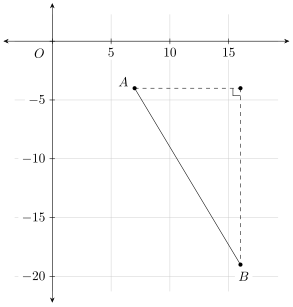
The points A(7,−4)A(7, -4) and B(16,−19)B(16, -19) are shown on the number plane. Find the length of ABAB, correct to the nearest whole number.

Figure

Worked solution

AB=(16−7)2+(−19−(−4))2=92+152=306=334AB = \sqrt{(16 - 7)^2 + (-19 - (-4))^2} = \sqrt{9^2 + 15^2} = \sqrt{306} = 3\sqrt{34}.

AB≈17AB \approx 17 (correct to the nearest whole number).

Answer

1717

Marking guidelines

Applies the distance formula with the coordinates of the two points

1 mark

Evaluates and rounds the length to the nearest whole number

1 mark

Report a problem with this question.

Question 23 marksMedium

The points A(−6,−5)A(-6, -5), B(−3,4)B(-3, 4) and C(k,−11)C(k, -11) lie on the same straight line. Find the value of kk.

Worked solution

Gradient of AB=4−(−5)(−3)−(−6)=3AB = \dfrac{4 - (-5)}{(-3) - (-6)} = 3

Gradient of AC=(−11)−(−5)k+6=3AC = \dfrac{(-11) - (-5)}{k + 6} = 3, so k+6=(−2)k + 6 = (-2)

k=(−2)+(−6)=−8k = (-2) + (-6) = -8

Answer

−8-8

Marking guidelines

Finds the gradient of the line through the two known points

1 mark

Equates the gradient through the third point to it

1 mark

Solves for kk

1 mark

Report a problem with this question.

Not affiliated with NESA.