Year 9 Mathematics

Connecting quadratic and exponential rules with their graphs

Two worked questions, each with its solution and marking guidelines.

  • Questions at easy and medium levels
  • As short answer and multiple choice
  • Some with diagrams
  • New numbers every time, from 5,000+ templates across NSW Years 7 to 12

Two worked examples

Question 13 marksMedium

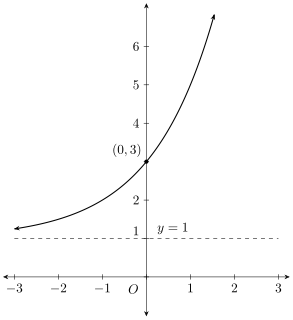
The diagram shows the graph of y=a×2x+ky=a\times2^x+k, where aa and kk are constants. The graph has the horizontal asymptote shown and passes through the point marked on the yy-axis. Find the value of yy when x=2x=2.

Figure

Worked solution

The asymptote is y=1y=1, so k=1k=1. The marked point (0,3)(0,3) gives a×20+1=3a\times 2^0+1=3, so a=2a=2.

So y=2×2x+1y=2\times 2^x+1.

When x=2x=2: y=2×22+1=9y=2\times 2^{2}+1=9.

Answer

99

Marking guidelines

Reads the vertical shift from the asymptote

1 mark

Uses the marked point on the yy-axis to find the multiplier

1 mark

Substitutes the given value of xx and evaluates

1 mark

Report a problem with this question.

Question 23 marksMedium

Find the yy-coordinate of the turning point of the parabola y=(x+17)(x+5)y = (x + 17)(x + 5).

Worked solution

y=0y = 0 when x=−17x = -17 and x=−5x = -5

The turning point is halfway between the intercepts: x=−222=−11x = \dfrac{-22}{2} = -11

y=(−11+17)(−11+5)=−36y = (-11 + 17)(-11 + 5) = -36

Answer

−36-36

Marking guidelines

Finds the xx-intercepts from the factors

1 mark

Uses symmetry to find the xx-coordinate of the turning point

1 mark

Substitutes to find the yy-coordinate

1 mark

Report a problem with this question.

Not affiliated with NESA.