
Year 9 Mathematics

Simplifying surds, simple surd operations and fractional indices

Two worked questions, each with its solution and marking guidelines.

  • Questions at easy and medium levels
  • As short answer and multiple choice
  • Some with diagrams
  • New numbers every time, from 5,000+ templates across NSW Years 7 to 12

Two worked examples

Question 13 marksMedium

Right-angled triangles are fitted together in the spiral shown. The first triangle has two short sides, each 3 cm3\text{ cm} long. Every later triangle has one short side of 3 cm3\text{ cm}, and its other short side is the hypotenuse of the triangle before it. Find the area of the fourth triangle. (Diagram not to scale.)
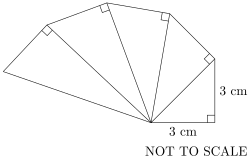
Figure

Worked solution

The squared hypotenuses are 2×322\times 3^2, 3×323\times 3^2 and 4×324\times 3^2 for the first three triangles, so the third hypotenuse is 4×3=6 cm\sqrt{4}\times 3=6\text{ cm}.

The fourth triangle has short sides 6 cm6\text{ cm} and 3 cm3\text{ cm}, so its area is 12×6×3=9 cm2\dfrac{1}{2}\times 6\times 3=9\text{ cm}^2.

Answer

9 cm29\text{ cm}^2

Marking guidelines

Uses the spiral pattern and Pythagoras to find the longer short side of the fourth triangle

2 marks

Uses the two short sides to find the area

1 mark

Report a problem with this question.

Question 22 marksMedium

Simplify 63+7\sqrt{63}+\sqrt{7} completely.

Worked solution

Extract the largest perfect-square factor from the first surd: 63=9×7=37\sqrt{63}=\sqrt{9\times7}=3\sqrt{7}.

Combine the like surds: 63+7=37+7=47\sqrt{63}+\sqrt{7}=3\sqrt{7}+\sqrt{7}=4\sqrt{7}.

Answer

474\sqrt{7}

Marking guidelines

Rewrites the first surd by pulling out its largest perfect-square factor

1 mark

Adds the like surds together to give the fully simplified answer

1 mark

Report a problem with this question.

Not affiliated with NESA.