Year 9 Mathematics

Volume of prisms, cylinders and composite solids

Two worked questions, each with its solution and marking guidelines.

  • Questions at easy and medium levels
  • As short answer and multiple choice
  • Some with diagrams
  • New numbers every time, from 5,000+ templates across NSW Years 7 to 12

Two worked examples

Question 12 marksEasier

A cylindrical drum has a radius of 1414 cm and a height of 3636 cm. There are 1000 cubic centimetres in a litre. Find the capacity of the drum in litres, correct to 1 decimal place.

Worked solution

V=Ï€r2h=Ï€(14)2(36)=7056Ï€V = \pi r^2 h = \pi(14)^2(36) = 7056\pi cubic centimetres

Capacity in litres: 7056π1000≈22.2\dfrac{7056\pi}{1000} \approx 22.2

Answer

22.222.2

Marking guidelines

Finds the volume of the cylinder in cubic centimetres

1 mark

Converts to litres and rounds to the required accuracy

1 mark

Report a problem with this question.

Question 23 marksMedium

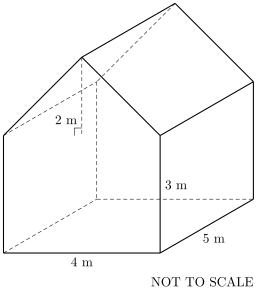
A shed has a rectangular floor 55 m long and 44 m wide, and its walls are 33 m high. The front and back walls are the two 44 m wide walls. The roof is a triangular prism whose two triangular ends are the front and back walls extended upwards, with the ridge 22 m above the top of the walls. Find the total volume enclosed by the shed, in cubic metres.

Figure

Worked solution

The rectangular part has volume 5×4×3=605 \times 4 \times 3 = 60 cubic metres.

The roof is a triangular prism with volume 12×4×2×5=20\frac{1}{2} \times 4 \times 2 \times 5 = 20 cubic metres.

V=60+20=80V = 60 + 20 = 80 cubic metres

Answer

8080

Marking guidelines

Finds the volume of the rectangular part

1 mark

Finds the volume of the triangular prism roof

1 mark

Adds the two volumes

1 mark

Report a problem with this question.

Not affiliated with NESA.