Year 10 Mathematics

Function notation, domain and range, interval notation

Two worked questions, each with its solution and marking guidelines.

  • Questions at easy and medium levels
  • As short answer and multiple choice
  • Some with diagrams
  • New numbers every time, from 5,000+ templates across NSW Years 7 to 12

Two worked examples

Question 12 marksMedium

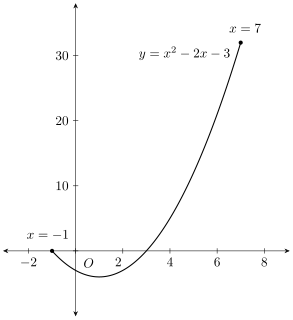
The diagram shows the graph of y=f(x)y = f(x) for values of xx from −1-1 to 77. Find the greatest value of f(x)f(x) on this domain.

Figure

Worked solution

From the diagram, f(x)=x2−2x−3f(x) = x^2 - 2x - 3 and both end points are included. f(−1)=(−1)2−2(−1)−3=0f(-1) = (-1)^2 - 2(-1) - 3 = 0 and f(7)=72−2(7)−3=32f(7) = 7^2 - 2(7) - 3 = 32.

The graph is a parabola opening upward with its lowest point at x=1x = 1, inside the domain, so the greatest value is at an end point: the larger of 00 and 3232 is 3232.

Answer

3232

Marking guidelines

Reads the rule from the graph and evaluates the function at both end points

1 mark

Identifies the larger end value as the greatest value

1 mark

Report a problem with this question.

Question 23 marksEasier

Let f(x)=4x+10f(x) = 4x + 10 and g(x)=x2+2g(x) = x^2 + 2. Find g(f(−3))g(f(-3)).

Worked solution

f(−3)=4(−3)+10=−2f(-3) = 4(-3) + 10 = -2

g(f(−3))=g(−2)=(−2)2+2g(f(-3)) = g(-2) = (-2)^2 + 2

g(f(−3))=4+2=6g(f(-3)) = 4 + 2 = 6

Answer

66

Marking guidelines

Evaluates the inner function

1 mark

Substitutes the result into the outer function

1 mark

Evaluates the composite value

1 mark

Report a problem with this question.

Not affiliated with NESA.