Year 10 Mathematics

Graphing inequalities

Two worked questions, each with its solution and marking guidelines.

  • Questions at easy and medium levels
  • As short answer
  • Some with diagrams
  • New numbers every time, from 5,000+ templates across NSW Years 7 to 12

Two worked examples

Question 13 marksMedium

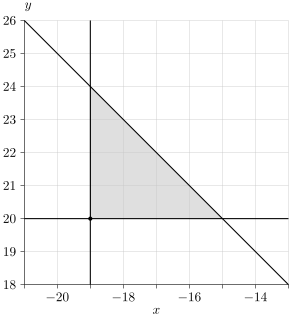
How many points with whole-number coordinates satisfy all of x≥−19x \ge -19, y≥20y \ge 20 and x+y≤5x + y \le 5?

Figure

Worked solution

Let u=x+19u = x + 19 and v=y−20v = y - 20. Then u≥0u \ge 0, v≥0v \ge 0 and u+v≤5−(−19)−20=4u + v \le 5 - (-19) - 20 = 4

For u=0,1,2,…,4u = 0, 1, 2, \dots, 4 the number of values of vv is 5,4,…,15, 4, \dots, 1

Total =(4+1)(4+2)2=15= \dfrac{(4+1)(4+2)}{2} = 15

Answer

1515

Marking guidelines

Shifts the variables so both lower limits become zero and finds the resulting total

1 mark

Counts the whole-number points for each value of the first variable

1 mark

Adds them to find the total number of points

1 mark

Report a problem with this question.

Question 23 marksMedium

Count the points (x,y)(x, y) with whole-number coordinates that satisfy all of −12≤x≤12-12 \le x \le 12, −12≤y≤12-12 \le y \le 12, x<0x < 0 and y≥x+5y \ge x + 5.

Worked solution

Since x<0x < 0 and x≥−12x \ge -12, the whole values are x=−12,…,−1x = -12, \dots, -1, which is 12 values.

For each xx, yy runs from x+5x + 5 to 12, giving 12−x−5+112 - x - 5 + 1 values: 20 for x=−12x = -12 down to 9 for x=−1x = -1.

These form an arithmetic sequence, so the sum is 12(20+9)2\dfrac{12(20 + 9)}{2}.

The total is 174.

Answer

174174

Marking guidelines

Lists the allowed whole values of the first coordinate

1 mark

Finds the number of allowed second coordinates for each of them

1 mark

Sums the counts to find the total

1 mark

Report a problem with this question.

Not affiliated with NESA.