Year 10 Mathematics

Polynomials and cubic equations: operations, division, the factor and remainder theorems, and graphs

Two worked questions, each with its solution and marking guidelines.

  • Questions at easy and medium levels
  • As short answer and multiple choice
  • Some with diagrams
  • New numbers every time, from 5,000+ templates across NSW Years 7 to 12

Two worked examples

Question 12 marksEasier

Find the remainder when P(x)=x3+6x2+x−3P(x) = x^3 + 6x^2 + x - 3 is divided by x+3x + 3.

Worked solution

By the remainder theorem, the remainder is P(−3)P(-3).

P(−3)=(−3)3+6(−3)2+(−3)−3P(-3) = (-3)^3 + 6(-3)^2 + (-3) - 3

=−27+54−3−3=21= -27 + 54 - 3 - 3 = 21

Answer

2121

Marking guidelines

Recognises that the remainder is the value of the polynomial where the divisor is zero

1 mark

Substitutes and evaluates to find the remainder

1 mark

Report a problem with this question.

Question 23 marksMedium

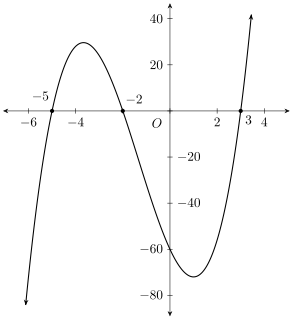
The diagram shows the graph of the cubic y=2x3+bx2+cx+dy=2x^3+bx^2+cx+d, where bb, cc and dd are constants. The graph crosses the xx-axis at the three points marked. Find the value of cc.

Figure

Worked solution

The graph crosses the xx-axis at x=−5x=-5, −2-2 and 33, so y=2(x+5)(x+2)(x−3)y=2(x+5)(x+2)(x-3).

The coefficient of xx in (x+5)(x+2)(x−3)(x+5)(x+2)(x-3) is 5(2)+5(−3)+2(−3)=−115(2)+5(-3)+2(-3)=-11.

So c=2×(−11)=−22c=2\times(-11)=-22.

Answer

−22-22

Marking guidelines

Writes the cubic in factorised form using the marked intercepts and the given leading coefficient

1 mark

Finds the coefficient of xx in the product of the three linear factors

1 mark

Multiplies by the leading coefficient to find cc

1 mark

Report a problem with this question.

Not affiliated with NESA.