Year 10 Mathematics

Surface area of cones and spheres

Two worked questions, each with its solution and marking guidelines.

  • Questions at easy and medium levels
  • As short answer and multiple choice
  • Some with diagrams
  • New numbers every time, from 5,000+ templates across NSW Years 7 to 12

Two worked examples

Question 12 marksEasier

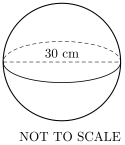
The diagram shows a ball with a diameter of 30 cm30\text{ cm}. Find the surface area of the ball, correct to 1 decimal place.
Figure

Worked solution

Radius =302=15 cm=\dfrac{30}{2}=15\text{ cm}.

Surface area =4π×152≈2827.4 cm2=4\pi\times 15^2\approx 2827.4\text{ cm}^2.

Answer

2827.42827.4

Marking guidelines

Halves the diameter to find the radius

1 mark

Substitutes the radius into the surface area formula for a sphere

1 mark

Report a problem with this question.

Question 23 marksMedium

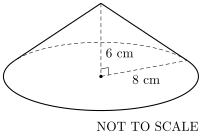
A solid cone has a base radius of 88 cm and a perpendicular height of 66 cm. Its total surface area can be written as kπk\pi square centimetres. Find the value of kk.

Figure

Worked solution

The slant height is l=82+62=10l = \sqrt{8^2 + 6^2} = 10 cm.

A=Ï€r2+Ï€rl=Ï€(8)2+Ï€(8)(10)A = \pi r^2 + \pi r l = \pi(8)^2 + \pi(8)(10)

=64Ï€+80Ï€=144Ï€= 64\pi + 80\pi = 144\pi, so k=144k = 144

Answer

144144

Marking guidelines

Uses Pythagoras to find the slant height

1 mark

Substitutes into the formula for the total surface area of a cone

1 mark

Simplifies to a multiple of pi and states the multiple

1 mark

Report a problem with this question.

Not affiliated with NESA.