Year 12 Mathematics Advanced

Transformations of trigonometric functions

Two worked questions, each with its solution and marking guidelines. Tutors: get a whole lesson sheet on this topic, made for your student.

  • Questions at easy, medium and hard levels
  • As short answer and multiple choice
  • Some with diagrams
  • New numbers every time, from 5,000+ templates across NSW Years 7 to 12
For tutors

Get a free lesson sheet

Made for your student, on any topic in Year 12 Mathematics Advanced, with worked solutions and a marking guide. By email, in under a minute.

  • Their name on their copy
  • Easy, medium or hard
  • No account needed
Get my free sheet

Two worked examples

Question 12 marksEasier

The temperature HH (in degrees Celsius) in a storage warehouse tt hours after it opens is given by H(t)=24+21sin⁡(π12t)H(t) = 24 + 21\sin\left(\dfrac{\pi}{12}t\right) for t∈[0,24]t \in [0, 24]. What are the minimum and maximum temperatures in the warehouse?

Worked solution

Since −1≤sin⁡(π12t)≤1-1 \le \sin\left(\dfrac{\pi}{12}t\right) \le 1, the minimum is 24−21=324 - 21 = 3.

The maximum is 24+21=4524 + 21 = 45.

Answer

The minimum temperature is 33 and the maximum temperature is 4545.

Marking guidelines

Correct minimum 3∘3^\circC

1 mark

Correct maximum 45∘45^\circC

1 mark

Report a problem with this question.

Question 22 marksMedium

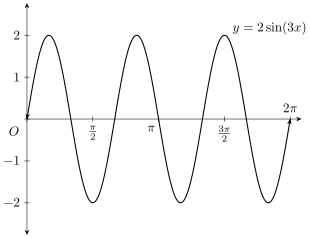
The diagram shows the graph of y=2sin⁡(bx)y = 2\sin(bx) for 0≤x≤2π0 \le x \le 2\pi, where bb is a whole number shown in the equation beside the curve. The curve first reaches the height y=1y = 1 at a positive value of xx. Find this value of xx in radians, correct to 2 decimal places.

Figure

Worked solution

From the diagram, b=3b = 3, so 2sin⁡(3x)=12\sin(3x) = 1 and sin⁡(3x)=12\sin(3x) = \dfrac{ 1 }{ 2 }.

3x=sin⁡−1 ⁣(12)≈0.52363x = \sin^{-1}\!\left(\dfrac{ 1 }{ 2 }\right) \approx 0.5236, so x≈0.17x \approx 0.17 radians.

Answer

0.170.17

Marking guidelines

Reads the number of cycles from the diagram and isolates the sine

1 mark

Takes the inverse sine in radians and divides by the number of cycles

1 mark

Report a problem with this question.

Not affiliated with NESA.