Year 12 Mathematics Advanced

Turning points, inflections and graphing

Two worked questions, each with its solution and marking guidelines. Tutors: get a whole lesson sheet on this topic, made for your student.

  • Questions at easy, medium and hard levels
  • As short answer and multiple choice
  • Some with diagrams
  • New numbers every time, from 5,000+ templates across NSW Years 7 to 12
For tutors

Get a free lesson sheet

Made for your student, on any topic in Year 12 Mathematics Advanced, with worked solutions and a marking guide. By email, in under a minute.

  • Their name on their copy
  • Easy, medium or hard
  • No account needed
Get my free sheet

Two worked examples

Question 12 marksEasier

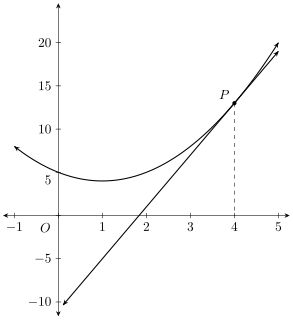
The diagram shows the curve y=x2−2x+5y = x^2 - 2x + 5 and the tangent to the curve at the point PP. The xx-coordinate of PP is marked on the xx-axis. Find the gradient of the tangent at PP.

Figure

Worked solution

From the diagram, PP is at x=4x = 4. Differentiating, dydx=2x−2\dfrac{dy}{dx} = 2x - 2.

At x=4x = 4 the gradient is 2(4)−2=62(4) - 2 = 6.

Answer

66

Marking guidelines

Differentiates the equation of the curve

1 mark

Substitutes the marked x-coordinate to find the gradient

1 mark

Report a problem with this question.

Question 23 marksMedium

The cubic curve y=x3+3x2−24x−20y = x^3 + 3x^2 - 24x - 20 has two turning points, and both have integer xx-coordinates. Find the coordinates of the local maximum point.

Worked solution

f′(x)=3x2+2(3)x−24=0f'(x) = 3x^2 + 2(3)x - 24 = 0

3(x+4)(x−2)=03(x + 4)(x - 2) = 0, so x=−4x = -4 or x=2x = 2

f′(x)f'(x) changes sign from positive to negative at x=−4x = -4, so the local maximum is at x=−4x = -4

f(−4)=(−4)3+3(−4)2+(−24)(−4)+(−20)=60f(-4) = (-4)^3 + 3(-4)^2 + (-24)(-4) + (-20) = 60

Answer

The local maximum point is (x,y)=(−4,60)(x, y) = (-4, 60).

Marking guidelines

Differentiates the cubic term by term

1 mark

Factorises the derivative and solves it to find the turning points

1 mark

Uses the sign change of the derivative to identify the maximum and substitutes to find its height

1 mark

Report a problem with this question.

Not affiliated with NESA.