Year 12 Mathematics Advanced

Using derivatives

Two worked questions, each with its solution and marking guidelines. Tutors: get a whole lesson sheet on this topic, made for your student.

  • Questions at easy, medium and hard levels
  • As short answer and multiple choice
  • Some with diagrams
  • New numbers every time, from 5,000+ templates across NSW Years 7 to 12
For tutors

Get a free lesson sheet

Made for your student, on any topic in Year 12 Mathematics Advanced, with worked solutions and a marking guide. By email, in under a minute.

  • Their name on their copy
  • Easy, medium or hard
  • No account needed
Get my free sheet

Two worked examples

Question 12 marksMedium

Find dydx\dfrac{dy}{dx} for y=12x+2113−xy = \dfrac{ 12x + 21 }{ 13 - x }, simplifying fully.

Worked solution

Quotient rule with u=12x+21u = 12x + 21 and v=13−xv = 13 - x, so u′=12u' = 12 and v′=−1v' = -1.

dydx=12(13−x)−(12x+21)(−1)(13−x)2=12(13−x)+12x+21(13−x)2\dfrac{dy}{dx} = \dfrac{ 12(13 - x) - (12x + 21)(-1) }{ (13 - x)^2 } = \dfrac{ 12(13 - x) + 12x + 21 }{ (13 - x)^2 }.

The xx terms cancel, leaving the numerator 156+21=177156 + 21 = 177, so dydx=177(13−x)2\dfrac{dy}{dx} = \dfrac{ 177 }{ (13 - x)^2 }.

Answer

177(13−x)2\dfrac{ 177 }{ (13 - x)^2 }

Marking guidelines

Applies the quotient rule with correct derivatives of the numerator and denominator

1 mark

Shows that the xx terms cancel in the numerator

1 mark

Report a problem with this question.

Question 24 marksMedium

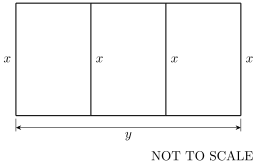
The diagram shows a rectangular enclosure divided into equal pens by barriers of length xx metres. The two long sides each have length yy metres. A zoo uses exactly 2020 m of fencing for the whole enclosure, including all the barriers. Find the greatest possible total area of the enclosure. (Diagram not to scale.)

Figure

Worked solution

Four barriers of length xx and two sides of length yy use all the fencing: 4x+2y=204x+2y=20, so y=10−2xy=10-2x.

A=xy=x(10−2x)=10x−2x2A=xy=x(10-2x)=10x-2x^2.

dAdx=10−4x=0\dfrac{dA}{dx}=10-4x=0 gives x=2.5x=2.5, and d2Adx2=−4<0\dfrac{d^2A}{dx^2}=-4<0 so this is a maximum.

y=10−2(2.5)=5y=10-2(2.5)=5 and A=2.5×5=12.5A=2.5\times5=12.5 m2^2.

Answer

12.512.5

Marking guidelines

Writes the length of the long sides in terms of the barrier length

1 mark

Forms the area as a function of the barrier length

1 mark

Differentiates and finds the value giving the maximum

1 mark

Finds the maximum area

1 mark

Report a problem with this question.

Not affiliated with NESA.