
Year 12 Mathematics Extension 1

Introduction to 2D and 3D vectors

Two worked questions, each with its solution and marking guidelines. Tutors: get a whole lesson sheet on this topic, made for your student.

  • Questions at easy and medium levels
  • As short answer and multiple choice
  • Some with diagrams
  • New numbers every time, from 5,000+ templates across NSW Years 7 to 12
For tutors

Get a free lesson sheet

Made for your student, on any topic in Year 12 Mathematics Extension 1, with worked solutions and a marking guide. By email, in under a minute.

  • Their name on their copy
  • Easy, medium or hard
  • No account needed
Get my free sheet

Two worked examples

Question 12 marksEasier

The diagram shows a straight cable joining the points AA and BB in three-dimensional space. Relative to the origin, with distances in metres, AA has position vector a=(91513)\mathbf{a}=\begin{pmatrix} 9 \\ 15 \\ 13 \end{pmatrix} and BB has position vector b=(1510)\mathbf{b}=\begin{pmatrix} 1 \\ 5 \\ 10 \end{pmatrix}. Find the length of the cable ABAB, correct to 1 decimal place. (Diagram not to scale.)
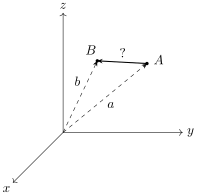
Figure

Worked solution

AB→=b−a=(1510)−(91513)=(−8−10−3)\overrightarrow{AB}=\mathbf{b}-\mathbf{a}=\begin{pmatrix} 1 \\ 5 \\ 10 \end{pmatrix}-\begin{pmatrix} 9 \\ 15 \\ 13 \end{pmatrix}=\begin{pmatrix} -8 \\ -10 \\ -3 \end{pmatrix}.

∣AB→∣=(−8)2+(−10)2+(−3)2≈13.2 m|\overrightarrow{AB}|=\sqrt{(-8)^2+(-10)^2+(-3)^2}\approx 13.2\text{ m}.

Answer

13.213.2

Marking guidelines

Finds the vector from the first point to the second by subtracting the position vectors

1 mark

Finds its magnitude from the three components to the stated accuracy

1 mark

Report a problem with this question.

Question 23 marksMedium

Relative to the origin OO, the points AA and BB have position vectors OA→=−11i+3j\overrightarrow{OA}=-11\mathbf{i}+ 3\mathbf{j} and OB→=−19i−12j\overrightarrow{OB}=-19\mathbf{i}- 12\mathbf{j}.

The point PP lies on the interval ABAB and divides it internally in the ratio 2:32:3, so that AP:PB=2:3AP:PB=2:3. Find the distance OPOP, correct to 2 decimal places.

Worked solution

OP→=OA→+25(OB→−OA→)=3OA→+2OB→5\overrightarrow{OP}=\overrightarrow{OA}+\dfrac{2}{5}\left(\overrightarrow{OB}-\overrightarrow{OA}\right)=\dfrac{3\overrightarrow{OA}+2\overrightarrow{OB}}{5}

OP→=3(−11)+2(−19)5i+3(3)+2(−12)5j=(−14.2)i+(−3.0)j\overrightarrow{OP}=\dfrac{3(-11)+2(-19)}{5}\mathbf{i}+\dfrac{3(3)+2(-12)}{5}\mathbf{j}=(-14.2)\mathbf{i}+(-3.0)\mathbf{j}

∣OP→∣=(−14.2)2+(−3.0)2≈14.51|\overrightarrow{OP}|=\sqrt{(-14.2)^2+(-3.0)^2}\approx 14.51

Answer

14.5114.51

Marking guidelines

Finds the position vector of the dividing point using the given ratio

1 mark

Evaluates the components of the position vector

1 mark

Finds the magnitude of the position vector and rounds to the required accuracy

1 mark

Report a problem with this question.

Not affiliated with NESA.