Year 12 Mathematics Extension 1

Motion in vector form in two dimensions

Two worked questions, each with its solution and marking guidelines. Tutors: get a whole lesson sheet on this topic, made for your student.

  • Questions at easy and medium levels
  • As short answer and multiple choice
  • Some with diagrams
  • New numbers every time, from 5,000+ templates across NSW Years 7 to 12
For tutors

Get a free lesson sheet

Made for your student, on any topic in Year 12 Mathematics Extension 1, with worked solutions and a marking guide. By email, in under a minute.

  • Their name on their copy
  • Easy, medium or hard
  • No account needed
Get my free sheet

Two worked examples

Question 13 marksMedium

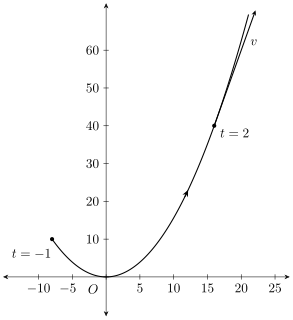
A particle moves in a plane so that at time tt seconds its position is x=8tx=8t, y=10t2y=10t^2, in metres. The diagram shows its path, with the particle's velocity vv drawn at one of the two marked points, each labelled with its value of tt. Find the speed of the particle at the marked point where vv is drawn.

Figure

Worked solution

The velocity components are dxdt=8\dfrac{dx}{dt}=8 and dydt=20t\dfrac{dy}{dt}=20t.

The velocity is drawn at t=2t=2, where dydt=40\dfrac{dy}{dt}=40.

Speed =82+402=1664=826=\sqrt{ 8^2+40^2 }=\sqrt{ 1664 }=8\sqrt{26}.

Answer

8268\sqrt{26}

Marking guidelines

Differentiates both components of the position

1 mark

Reads the time of the marked point and evaluates the velocity components there

1 mark

Finds the magnitude of the velocity

1 mark

Report a problem with this question.

Question 24 marksMedium

A particle moves in a plane. Its acceleration, in metres per second squared, at time tt seconds is

a(t)=2t i+3 j.\mathbf{a}(t) = 2t\,\mathbf{i} + 3\,\mathbf{j}.

When t=0t = 0 the velocity of the particle is (3i+5j)(3\mathbf{i} + 5\mathbf{j}) metres per second.

Find the speed of the particle, in metres per second, when t=2t = 2, correct to 1 decimal place.

Worked solution

v(t)=(t2+3)i+(3t+5)j\mathbf{v}(t) = (t^2 + 3)\mathbf{i} + (3t + 5)\mathbf{j}

v(2)=7i+11j\mathbf{v}(2) = 7\mathbf{i} + 11\mathbf{j}

∣v(2)∣=72+112=170≈13.0|\mathbf{v}(2)| = \sqrt{7^2 + 11^2} = \sqrt{170} \approx 13.0

Answer

13.013.0

Marking guidelines

Integrates the acceleration vector to find the velocity vector with constants of integration

1 mark

Uses the initial velocity to find the constants of integration

1 mark

Substitutes the given time to find the velocity components

1 mark

Finds the magnitude of the velocity correct to the required accuracy

1 mark

Report a problem with this question.

Not affiliated with NESA.