Year 12 Mathematics Extension 2

Arithmetic of complex numbers

Two worked questions, each with its solution and marking guidelines.

  • Questions at easy, medium and hard levels
  • As short answer and multiple choice
  • Some with diagrams
  • New numbers every time, from 5,000+ templates across NSW Years 7 to 12

Two worked examples

Question 14 marksMedium

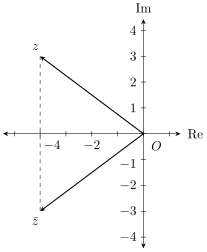
The diagram shows z=−4+3iz=-4+3i and its conjugate zˉ\bar z. Find the area of the triangle whose vertices are zz, zˉ\bar z and z4z^4. (Diagram not to scale.)

Figure

Worked solution

z2=(−4+3i)2=7−24iz^2=(-4+ 3i)^2=7- 24i.

z4=(z2)2=−527−336iz^4=(z^2)^2=-527- 336i, so the real part of z4z^4 is −527-527.

The side from zz to zˉ\bar z is vertical with length 2×3=62\times3=6, on the line Re⁡=−4\operatorname{Re}=-4. The perpendicular distance from z4z^4 to this line is ∣−527+4∣=523|-527+ 4|=523.

Area =12×6×523=1569=\dfrac12\times6\times523=1569 square units.

Answer

15691569

Marking guidelines

Expands the square of the number

1 mark

Squares again to find the real part of the fourth power

1 mark

Identifies the base of the triangle and the perpendicular height using the vertical line joining the conjugates

1 mark

Calculates the area

1 mark

Report a problem with this question.

Question 22 marksEasier

Let w=4−iw = 4 - i and z=1+iz = 1 + i. The ratio wz\dfrac{w}{z} can be written as 1N(x+yi)\dfrac{1}{N}(x + yi), where NN is the squared modulus of zz and xx and yy are integers. Find xx and yy.

Worked solution

Multiply top and bottom by the conjugate 1−i1 - i of the divisor.

The numerator is (4−i)(1−i)=3−5i(4 - i)(1 - i) = 3 - 5i and the denominator is 12+12=21^2 + 1^2 = 2.

So the ratio is 12(3−5i)\dfrac{1}{2}(3 - 5i), giving x=3x = 3 and y=−5y = -5.

Answer

x=3x = 3, y=−5y = -5

Marking guidelines

Multiplies numerator and denominator by the conjugate of the denominator

1 mark

Expands the numerator and finds the squared modulus of the denominator

1 mark

Report a problem with this question.

Not affiliated with NESA.