Year 12 Mathematics Extension 2

Describing lines, curves and regions

Two worked questions, each with its solution and marking guidelines.

  • Questions at easy, medium and hard levels
  • As short answer and multiple choice
  • Some with diagrams
  • New numbers every time, from 5,000+ templates across NSW Years 7 to 12

Two worked examples

Question 12 marksMedium

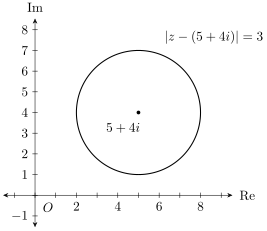
The complex number zz satisfies ∣z−(5+4i)∣=3|z - (5 + 4i)| = 3, as shown in the diagram. Find the greatest possible value of ∣z∣|z|, correct to 2 decimal places.

Figure

Worked solution

The equation describes a circle with centre 5+4i5 + 4 i and radius 33.

The distance from OO to the centre is 52+42≈6.40\sqrt{5^2+ 4^2} \approx 6.40.

The greatest value of ∣z∣|z| is the distance from OO to the centre plus the radius, so ∣z∣=52+42+3≈9.40|z| = \sqrt{5^2+ 4^2}+ 3 \approx 9.40.

Answer

9.409.40

Marking guidelines

Identifies the centre and radius of the circle from the equation

1 mark

Adds the radius to the distance from the origin to the centre to find the greatest modulus

1 mark

Report a problem with this question.

Question 23 marksMedium

The complex number zz satisfies ∣z−9∣=2∣z−1∣|z - 9| = 2|z - 1|. The locus of zz is a circle. Find its radius.

Worked solution

Let z=x+iyz = x + iy. Squaring, (x−9)2+y2=4[(x−1)2+y2](x - 9)^2 + y^2 = 4\left[(x - 1)^2 + y^2\right]

x2+y2+103x=773x^2 + y^2 + \dfrac{10}{3}x = \dfrac{77}{3}, so (x+53)2+y2=773+259=2569(x + \dfrac{5}{3})^2 + y^2 = \dfrac{77}{3} + \dfrac{25}{9} = \dfrac{256}{9}

The radius is 2569=163\sqrt{\dfrac{256}{9}} = \dfrac{16}{3}

Answer

163\dfrac{16}{3}

Marking guidelines

Writes zz in terms of real and imaginary parts and squares both sides of the equation

1 mark

Expands and completes the square to reach the standard form of a circle

1 mark

States the radius

1 mark

Report a problem with this question.

Not affiliated with NESA.