Year 12 Mathematics Extension 2

Forces and further motion in a straight line

Two worked questions, each with its solution and marking guidelines.

  • Questions at easy, medium and hard levels
  • As short answer and multiple choice
  • Some with diagrams
  • New numbers every time, from 5,000+ templates across NSW Years 7 to 12

Two worked examples

Question 12 marksMedium

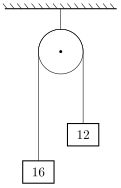
A light inextensible string passes over a smooth, light pulley. Masses of 16 kg and 12 kg hang from the two ends, with 16 kg the heavier. Taking g=10 m s−2g=10\text{ m s}^{-2}, find the acceleration of the system, correct to one decimal place.
Figure

Worked solution

For the heavier mass: 16(10)−T=16a16(10)-T=16a; for the lighter mass: T−12(10)=12aT-12(10)=12a.

Adding the two equations: (16−12)(10)=(16+12)a(16-12)(10)=(16+12)a, so a=4028≈1.4a=\dfrac{40}{28}\approx 1.4 m s−2^{-2}.

Answer

1.41.4

Marking guidelines

Applies Newton's second law to each mass and adds the two equations

1 mark

Solves for the acceleration of the system and rounds to the required accuracy

1 mark

Report a problem with this question.

Question 23 marksMedium

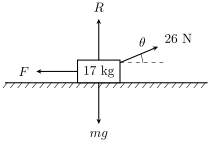
In the diagram, a block of mass 1717 kg is pulled along a rough horizontal floor by a force of 2626 N acting at an angle θ\theta above the horizontal, where sin⁡θ=513\sin\theta=\dfrac{5}{13}. The block moves at constant speed. Take g=10g=10 m/s2^2. Find the coefficient of friction between the block and the floor.

Figure

Worked solution

Horizontally, at constant speed: F=Pcos⁡θ=26×1213=24F=P\cos\theta=26\times\dfrac{12}{13}=24 N.

Vertically: R=mg−Psin⁡θ=17×10−26×513=170−10=160R=mg-P\sin\theta=17\times 10-26\times\dfrac{5}{13}=170-10=160 N.

μ=FR=24160=0.15\mu=\dfrac{F}{R}=\dfrac{24}{160}=0.15.

Answer

0.150.15

Marking guidelines

Resolves horizontally to find the friction force

1 mark

Resolves vertically to find the normal reaction

1 mark

Divides friction by normal reaction to find the coefficient

1 mark

Report a problem with this question.

Not affiliated with NESA.