Year 12 Mathematics Extension 2

Modelling motion without resistance

Two worked questions, each with its solution and marking guidelines.

  • Questions at easy, medium and hard levels
  • As short answer and multiple choice
  • Some with diagrams
  • New numbers every time, from 5,000+ templates across NSW Years 7 to 12

Two worked examples

Question 12 marksMedium

A stone is thrown horizontally at 1717 m/s from the top of a cliff. It hits the sea 2.22.2 seconds later. Ignore air resistance and take g=10g = 10 m/s2^2. Find the speed of the stone, in m/s, as it hits the sea, correct to 1 decimal place.

Worked solution

Vertical speed at impact: vy=10×2.2=22v_y = 10 \times 2.2 = 22

Speed =172+222=773≈27.8= \sqrt{17^2 + 22^2} = \sqrt{773} \approx 27.8

Answer

27.827.8

Marking guidelines

Finds the vertical component of velocity at impact

1 mark

Combines the components and gives the speed to the required accuracy

1 mark

Report a problem with this question.

Question 23 marksMedium

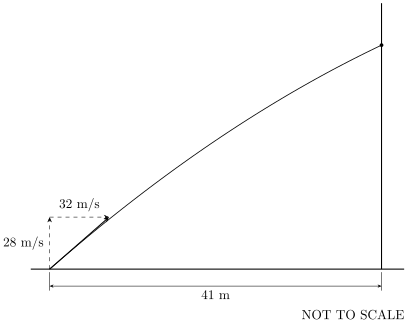
A ball is projected from level ground with initial horizontal and vertical velocity components of 3232 m/s and 2828 m/s respectively. It strikes a vertical wall 4141 m away before it reaches the ground again. Ignore air resistance and take g=10g = 10 m/s2^2. Find the height, in metres, above the ground at which the ball hits the wall. Give your answer correct to 2 decimal places.

Figure

Worked solution

Time to reach the wall: t=4132≈1.281t = \frac{41}{32} \approx 1.281

y≈28(1.281)−5(1.281)2y \approx 28(1.281) - 5(1.281)^2

y≈35.875−8.208≈27.67y \approx 35.875 - 8.208 \approx 27.67

Answer

27.6727.67

Marking guidelines

Finds the time taken to reach the wall from the horizontal motion

1 mark

Substitutes the time into the vertical displacement equation

1 mark

Evaluates the height

1 mark

Report a problem with this question.

Not affiliated with NESA.