Year 12 Mathematics Extension 2

Powers and roots of complex numbers

Two worked questions, each with its solution and marking guidelines.

  • Questions at easy, medium and hard levels
  • As short answer and multiple choice
  • Some with diagrams
  • New numbers every time, from 5,000+ templates across NSW Years 7 to 12

Two worked examples

Question 12 marksMedium

The complex number z=k+12iz = k + 12i, where kk is a positive real number. Given that z3z^3 is purely imaginary, find the exact value of kk.

Worked solution

z3=(k3−3k(12)2)+(3k2(12)−(12)3)iz^3 = (k^3 - 3k(12)^2) + (3k^2(12) - (12)^3)i

z3z^3 is purely imaginary, so k3−432k=0k^3 - 432k = 0, giving k2=432k^2 = 432 (as k≠0k \neq 0)

k>0k > 0, so k=432=123k = \sqrt{432} = 12 \sqrt{3}

Answer

12312 \sqrt{3}

Marking guidelines

Expands the cube and identifies the real part

1 mark

Sets the real part equal to zero and solves for the positive value

1 mark

Report a problem with this question.

Question 23 marksEasier

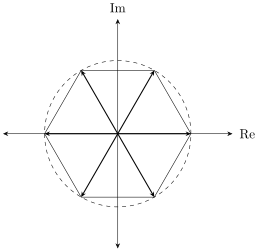
The six distinct sixth roots of a complex number ww are each at distance 222\sqrt{2} from the origin in the Argand plane. Joining the roots in order forms a regular hexagon. Find the exact area of the hexagon.

You may use sin⁡π3=32\sin\dfrac{\pi}{3} = \dfrac{\sqrt{3}}{2}.

Figure

Worked solution

The roots lie on a circle of radius 222\sqrt{2} and adjacent roots subtend 2π6=π3\dfrac{2\pi}{6} = \dfrac{\pi}{3} at the centre

A=6×12(22)2sin⁡π3A = 6 \times \dfrac{1}{2}(2\sqrt{2})^2\sin\dfrac{\pi}{3} (6 triangles from the centre)

sin⁡π3=32\sin\dfrac{\pi}{3} = \dfrac{\sqrt{3}}{2}, so A=123A = 12\sqrt{3}

Answer

12312\sqrt{3}

Marking guidelines

Finds the angle at the centre between adjacent roots

1 mark

Writes the area as the number of triangles times half the product of two radii and the sine of that angle

1 mark

Evaluates the exact sine value and the area

1 mark

Report a problem with this question.

Not affiliated with NESA.