Year 12 Mathematics Extension 2

Projectiles and resisted motion

Two worked questions, each with its solution and marking guidelines.

  • Questions at easy, medium and hard levels
  • As short answer and multiple choice
  • Some with diagrams
  • New numbers every time, from 5,000+ templates across NSW Years 7 to 12

Two worked examples

Question 13 marksEasier

A particle is projected vertically upward with speed 1414 m/s. While it moves upward, its acceleration is −(10+0.3v)-(10 + 0.3v) m/s2^2, where vv m/s is its speed. Find the time, in seconds, taken to reach its greatest height, correct to 2 decimal places.

Worked solution

dvdt=−(10+0.3v)\frac{dv}{dt} = -(10 + 0.3v)

t=∫014110+0.3v dv=[10.3ln⁡(10+0.3v)]014t = \int_0^{14}\frac{1}{10 + 0.3v}\,dv = \left[\frac{1}{0.3}\ln(10 + 0.3v)\right]_0^{14}

t=10.3ln⁡10+0.3(14)10=10.3ln⁡14.210≈1.17t = \frac{1}{0.3}\ln\frac{10 + 0.3(14)}{10} = \frac{1}{0.3}\ln\frac{14.2}{10} \approx 1.17

Answer

1.171.17

Marking guidelines

Writes the acceleration as the rate of change of speed with time

1 mark

Separates the variables and integrates between the initial and final speeds

1 mark

Substitutes the limits and gives the time to the required accuracy

1 mark

Report a problem with this question.

Question 25 marksMedium

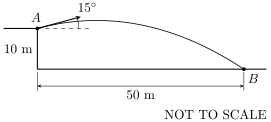
In the diagram a stone is thrown from the point AA at the top of a vertical cliff, 1010 m above level ground. It is thrown at 15∘15^\circ above the horizontal and lands at the point BB on the ground, 5050 m horizontally from the foot of the cliff. Ignore air resistance, treat the stone as a particle and take g=10g = 10 m/s2^2. Find the speed of the stone as it hits the ground at BB, in m/s, correct to 1 decimal place. (Diagram not to scale.)

Figure

Worked solution

Using y=h+xtan⁡α−5x2u2cos⁡2αy = h + x\tan\alpha - \dfrac{5x^2}{u^2\cos^2\alpha} with y=0y = 0 at x=50x = 50: u2=5×502cos⁡215∘ (10+50tan⁡15∘)u^2 = \dfrac{5\times 50^2}{\cos^2 15^\circ\,(10 + 50\tan 15^\circ)}.

So u2=572.6032u^2 = 572.6032.

Conservation of energy (or v2=u2+2ghv^2 = u^2 + 2gh) gives v2=u2+20×10v^2 = u^2 + 20\times 10.

v2=772.6032v^2 = 772.6032, so v≈27.8v \approx 27.8 m/s.

Answer

27.827.8

Marking guidelines

Writes the equation of the path for a launch from a height

1 mark

Substitutes the landing condition and solves for the square of the launch speed

2 marks

Uses the vertical drop to find the speed at impact

1 mark

Evaluates and rounds correctly

1 mark

Report a problem with this question.

Not affiliated with NESA.