Year 12 Mathematics Extension 2

Vector equations of lines and curves

Two worked questions, each with its solution and marking guidelines.

  • Questions at easy, medium and hard levels
  • As short answer and multiple choice
  • Some with diagrams
  • New numbers every time, from 5,000+ templates across NSW Years 7 to 12

Two worked examples

Question 12 marksEasier

A line has vector equation r=(3748)+λ(−484)\mathbf{r} = \begin{pmatrix}37\\4\\8\end{pmatrix} + \lambda\begin{pmatrix}-4\\8\\4\end{pmatrix}. The point PP on the line has xx-coordinate 2929.

Find the sum of the yy-coordinate and the zz-coordinate of PP.

Worked solution

x=37+(−4)λ=29x = 37 + (-4)\lambda = 29, so λ=2\lambda = 2

y=4+8(2)=20y = 4 + 8(2) = 20 and z=8+4(2)=16z = 8 + 4(2) = 16

y+z=20+16=36y + z = 20 + 16 = 36

Answer

3636

Marking guidelines

Uses the xx-component of the line to find the value of the parameter at PP

1 mark

Substitutes the parameter into the other two components and adds them

1 mark

Report a problem with this question.

Question 24 marksMedium

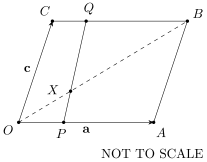
OABCOABC is a parallelogram with OA→=a\overrightarrow{OA} = \mathbf{a} and OC→=c\overrightarrow{OC} = \mathbf{c}, so that OB→=a+c\overrightarrow{OB} = \mathbf{a} + \mathbf{c}. The point PP lies on OAOA with OP=13 OAOP = \dfrac{ 1 }{ 3 }\, OA, and the point QQ lies on CBCB with CQ=14 CBCQ = \dfrac{ 1 }{ 4 }\, CB. The line PQPQ meets the diagonal OBOB at XX, where OX→=λ OB→\overrightarrow{OX} = \lambda\, \overrightarrow{OB}. Find λ\lambda as a fraction in lowest terms.

Figure

Worked solution

Take OO as origin, so BB has position vector a+c\mathbf{a} + \mathbf{c}. Then P=13aP = \dfrac{1}{3}\mathbf{a} and Q=c+14aQ = \mathbf{c} + \dfrac{1}{4}\mathbf{a}.

Write the point on PQPQ as X=P+s(Q−P)X = P + s(Q - P), which gives (13+s(14−13))a+s c\left(\dfrac{1}{3} + s\left(\dfrac{1}{4} - \dfrac{1}{3}\right)\right)\mathbf{a} + s\,\mathbf{c}.

Since XX is also on OBOB, X=λ(a+c)X = \lambda(\mathbf{a} + \mathbf{c}). Equating coefficients of c\mathbf{c} gives s=λs = \lambda and of a\mathbf{a} gives λ=13+λ(14−13)\lambda = \dfrac{1}{3} + \lambda\left(\dfrac{1}{4} - \dfrac{1}{3}\right).

Multiply through by 1212: 12λ=4+λ(3−4)12\lambda = 4 + \lambda(3 - 4), so λ(12−3+4)=4\lambda(12 - 3 + 4) = 4 and λ=413\lambda = \dfrac{4}{13}.

Answer

413\dfrac{4}{13}

Marking guidelines

Writes the position vectors of the two points on the sides in terms of the base vectors

1 mark

Expresses a point on the line through them with a parameter

1 mark

Equates coefficients of the independent base vectors using the diagonal

1 mark

Solves for the scalar and states it in lowest terms

1 mark

Report a problem with this question.

Not affiliated with NESA.