Year 12 Mathematics Extension 2

Vectors and geometry

Two worked questions, each with its solution and marking guidelines.

  • Questions at easy, medium and hard levels
  • As short answer and multiple choice
  • Some with diagrams
  • New numbers every time, from 5,000+ templates across NSW Years 7 to 12

Two worked examples

Question 12 marksEasier

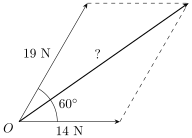
Two forces act on a point as shown in the diagram, with the angle between them marked. Find the magnitude of the resultant force. The sizes of the forces are 1414 N and 1919 N. Give your answer correct to 2 decimal places.
Figure

Worked solution

R2=142+192+2(14)(19)cos⁡60∘=196+361+266=823R^2=14^2+ 19^2+2(14)(19)\cos 60^\circ=196+ 361+ 266=823.

R=823≈28.69R= \sqrt{823} \approx 28.69 N.

Answer

28.6928.69

Marking guidelines

Applies the cosine rule or the vector sum to find the square of the resultant

1 mark

Takes the square root to find the magnitude of the resultant

1 mark

Report a problem with this question.

Question 23 marksMedium

The points A(10,−10,−5)A(10, -10, -5), B(−8,1,7)B(-8, 1, 7) and C(−6,−1,3)C(-6, -1, 3) form a triangle.

Find the size of angle ABCABC, in degrees, correct to 1 decimal place.

Worked solution

BA→=(18,−11,−12)\overrightarrow{BA} = (18, -11, -12) and BC→=(2,−2,−4)\overrightarrow{BC} = (2, -2, -4)

BA→⋅BC→=106\overrightarrow{BA}\cdot\overrightarrow{BC} = 106, ∣BA→∣=589|\overrightarrow{BA}| = \sqrt{589} and ∣BC→∣=24=26|\overrightarrow{BC}| = \sqrt{24} = 2\sqrt{6}

cos⁡∠ABC=10658924\cos\angle ABC = \dfrac{106}{\sqrt{589}\sqrt{24}}, so ∠ABC≈26.9∘\angle ABC \approx 26.9^\circ

Answer

26.926.9

Marking guidelines

Finds the vectors along the two sides meeting at the vertex

1 mark

Finds the dot product and the two magnitudes

1 mark

Uses the dot product formula to find the angle in degrees

1 mark

Report a problem with this question.

Not affiliated with NESA.