
Year 12 Mathematics Standard 2

Relative frequency and probability

Two worked questions, each with its solution and marking guidelines. Tutors: get a whole lesson sheet on this topic, made for your student.

  • Questions at easy and medium levels
  • As short answer and multiple choice
  • Some with diagrams
  • New numbers every time, from 5,000+ templates across NSW Years 7 to 12
For tutors

Get a free lesson sheet

Made for your student, on any topic in Year 12 Mathematics Standard 2, with worked solutions and a marking guide. By email, in under a minute.

  • Their name on their copy
  • Easy, medium or hard
  • No account needed
Get my free sheet

Two worked examples

Question 12 marksMedium

In a game, a fair coin is tossed and a fair die is rolled. The diagram shows all the possible outcomes, with the winning outcomes shaded. A player pays 77 dollars to play, and receives 2424 dollars if the outcome is shaded. Find the player's expected net gain per game, in dollars. Give your answer to the nearest cent.
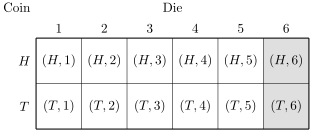
Figure

Worked solution

The shaded cells are (H,6)(H,6) and (T,6)(T,6): 22 of 1212 outcomes, so P(win)=212=16P(\text{win})=\dfrac{2}{12}=\dfrac{1}{6}.

Expected gain =16×24−7=−3.00=\dfrac{1}{6}\times 24-7=-3.00 dollars.

Answer

−3.00-3.00

Marking guidelines

Counts the shaded outcomes to find the probability of a win

1 mark

Finds the expected prize and subtracts the cost to play

1 mark

Report a problem with this question.

Question 23 marksMedium

A set of keys contains 1111 keys that open a shed and 1010 keys that do not. Two keys are taken from the set at random, one after the other, without replacement. Find the probability that both keys open the shed, or neither key opens the shed. Give your answer as a fraction in lowest terms.

Worked solution

Total keys =11+10=21= 11 + 10 = 21.

P(both open the shed)=1121×1020=110420=1142P(\text{both open the shed}) = \dfrac{11}{21} \times \dfrac{10}{20} = \dfrac{110}{420} = \dfrac{11}{42} and P(neither opens the shed)=1021×920=90420=314P(\text{neither opens the shed}) = \dfrac{10}{21} \times \dfrac{9}{20} = \dfrac{90}{420} = \dfrac{3}{14}

P(match)=110+90420=200420=1021P(\text{match}) = \dfrac{110 + 90}{420} = \dfrac{200}{420} = \dfrac{10}{21}

Answer

1021\dfrac{10}{21}

Marking guidelines

Finds the probability that both keys open the shed

1 mark

Finds the probability that neither key opens the shed, using the reduced count

1 mark

Adds the two probabilities and simplifies to lowest terms

1 mark

Report a problem with this question.

Not affiliated with NESA.