Year 7 Mathematics

Angles on parallel lines

Two worked questions, each with its solution and marking guidelines.

  • Questions at easy, medium and hard levels
  • As short answer and multiple choice
  • Some with diagrams
  • New numbers every time, from 5,000+ templates across NSW Years 7 to 12

Two worked examples

Question 13 marksMedium

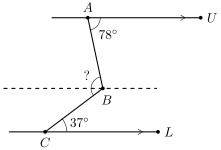
In the diagram, the two horizontal lines are parallel and the dotted line through BB is parallel to them. Angle UABUAB is 78∘78^\circ and angle LCBLCB is 37∘37^\circ. Find the size of angle ABCABC.

Figure

Worked solution

The dotted line is parallel to the upper line, so the alternate angle between BABA and the dotted line is 78∘78^\circ.

The dotted line is parallel to the lower line, so the alternate angle between BCBC and the dotted line is 37∘37^\circ.

Angle ABC=78+37=115∘ABC = 78 + 37 = 115^\circ

Answer

115∘115^\circ

Marking guidelines

Uses alternate angles with the dotted line to find the upper part of the bend

1 mark

Uses alternate angles with the dotted line to find the lower part of the bend

1 mark

Adds the two parts to find the angle at the bend

1 mark

Report a problem with this question.

Question 21 markEasier

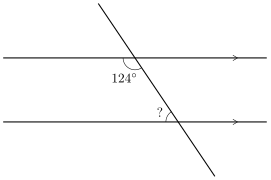
The diagram shows two parallel lines crossed by a straight line. The two marked angles are on the same side of the crossing line and between the parallel lines. One of them is 124∘124^\circ. What is the size of the other marked angle?

Figure

Worked solution

The lines are parallel, and the two marked angles are on the same side of the crossing line and between the parallel lines, so they are co-interior angles.

Co-interior angles on parallel lines add to 180∘180^\circ.

The angle marked ?? is 180∘−124∘=56∘180^\circ - 124^\circ = 56^\circ.

Answer

56∘56^\circ

Marking guidelines

Recognises co-interior angles and subtracts the given angle from a straight angle

1 mark

Report a problem with this question.

Not affiliated with NESA.