Year 7 Mathematics

Finding unknown angles with reasons

Two worked questions, each with its solution and marking guidelines.

  • Questions at easy and medium levels
  • As short answer and multiple choice
  • Some with diagrams
  • New numbers every time, from 5,000+ templates across NSW Years 7 to 12

Two worked examples

Question 12 marksMedium

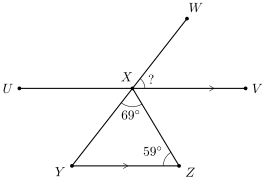
In the diagram, UVUV passes through XX and is parallel to YZYZ, and YXYX is extended to WW. Angle YXZYXZ is 69∘69^\circ and angle XZYXZY is 59∘59^\circ. What is the size of ∠VXW\angle VXW, in degrees?

Figure

Worked solution

Angles in triangle XYZXYZ add to 180∘180^\circ: ∠XYZ=180−69−59=52∘\angle XYZ = 180 - 69 - 59 = 52^\circ.

Alternate angles between the parallel lines: ∠UXY=∠XYZ=52∘\angle UXY = \angle XYZ = 52^\circ.

Vertically opposite angles: ∠VXW=∠UXY=52∘\angle VXW = \angle UXY = 52^\circ.

Answer

52∘52^\circ

Marking guidelines

Finds the angle of the triangle at the base using the angle sum

1 mark

Uses alternate angles and then vertically opposite angles to state the required angle

1 mark

Report a problem with this question.

Question 21 markMedium

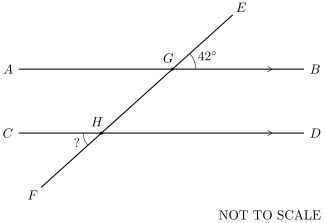
The diagram shows part of a map of a camping ground. Paths ABAB and CDCD are parallel, and the straight creek EFEF crosses them at GG and HH. Angle EGBEGB is 42∘42^\circ. What is the size of angle FHCFHC?

Figure

Worked solution

Angle EGBEGB and angle GHDGHD are corresponding angles on parallel paths, so GHD=42∘GHD = 42^\circ.

Angle FHCFHC is vertically opposite angle GHDGHD, so FHC=42∘FHC = 42^\circ.

Answer

42∘42^\circ

Marking guidelines

Uses corresponding and vertically opposite angles to find the size of the named angle

1 mark

Report a problem with this question.

Not affiliated with NESA.