Year 7 Mathematics

Angle sum of a triangle

Two worked questions, each with its solution and marking guidelines.

  • Questions at easy and medium levels
  • As short answer and multiple choice
  • Some with diagrams
  • New numbers every time, from 5,000+ templates across NSW Years 7 to 12

Two worked examples

Question 11 markMedium

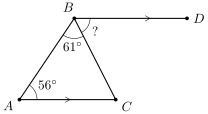
Sophie and Ali are making a triangular sign ABCABC for their fruit market stall. In the triangle, angle BACBAC is 56∘56^\circ and angle ABCABC is 61∘61^\circ. They draw a line from BB, called BDBD, that is parallel to ACAC and points the same way as ACAC does when you go from AA to CC. What is the size of angle CBDCBD?

Figure

Worked solution

The angles in a triangle add to 180∘180^\circ, so angle ACB=180∘−56∘−61∘=63∘ACB = 180^\circ - 56^\circ - 61^\circ = 63^\circ.

BDBD is parallel to ACAC, so angle CBDCBD and angle ACBACB are alternate angles and are equal.

Angle CBD=63∘CBD = 63^\circ.

Answer

63∘63^\circ

Marking guidelines

Uses the angle sum of a triangle to find the third angle and then uses alternate angles on parallel lines

1 mark

Report a problem with this question.

Question 21 markMedium

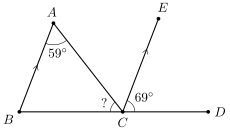
Rahul draws a diagram on Chloe's phone. Triangle ABCABC has its side BCBC on a straight base line, and the base line is extended past CC to a point DD. Rahul draws the ray CECE on the same side of the base line as AA, parallel to BABA. Angle ECDECD is 69∘69^\circ and angle BACBAC is 59∘59^\circ. What is the size of angle ACBACB?

Figure

Worked solution

CECE is parallel to BABA, so corresponding angles are equal: angle ABC=69∘ABC = 69^\circ.

Angles in a triangle add to 180∘180^\circ: angle ACB=180−69−59=52∘ACB = 180 - 69 - 59 = 52^\circ

Answer

52∘52^\circ

Marking guidelines

Uses the corresponding angle and the angle sum of a triangle to find the unknown angle

1 mark

Report a problem with this question.

Not affiliated with NESA.