
Year 7 Mathematics

Sample spaces, theoretical and experimental probability, complementary events, and two-step experiments

Two worked questions, each with its solution and marking guidelines.

  • Questions at easy and medium levels
  • As short answer and multiple choice
  • Some with diagrams
  • New numbers every time, from 5,000+ templates across NSW Years 7 to 12

Two worked examples

Question 11 markEasier

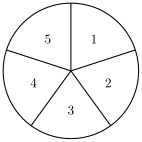
Jack spun the spinner shown in the diagram. It has five equal sectors, numbered 1 to 5. He spun it 20 times. The table shows how many times each number came up.

Number12345Times it came up26435\begin{array}{c|ccccc} \text{Number} & 1 & 2 & 3 & 4 & 5 \\ \hline \text{Times it came up} & 2 & 6 & 4 & 3 & 5 \end{array}

Using these results, what is the experimental chance, as a percentage, that the spinner shows a 2 or a 4?
Figure

Worked solution

The number of times a 2 or a 4 came up is 6+3=96 + 3 = 9.

The experimental chance is 920=45%\dfrac{9}{20} = 45\%.

Answer

45%45\%

Marking guidelines

Adds the results for the two numbers and gives the chance out of the total spins as a percentage

1 mark

Report a problem with this question.

Question 21 markEasier

Amira sells bus passes at a kiosk. Each pass comes in a coloured holder. The box on her counter holds these holders.

ColourRedBlueGreenYellowNumber of holders79106\begin{array}{c|cccc} \text{Colour} & \text{Red} & \text{Blue} & \text{Green} & \text{Yellow} \\ \hline \text{Number of holders} & 7 & 9 & 10 & 6 \end{array}

Leo takes one holder from the box without looking. What is the chance that it is green? Give your answer as a fraction in simplest form.

Worked solution

Number of holders: 7+9+10+6=327 + 9 + 10 + 6 = 32.

Chance of green =1032=516= \dfrac{10}{32} = \dfrac{5}{16}.

In simplest form this is 516\dfrac{5}{16}.

Answer

516\dfrac{5}{16}

Marking guidelines

Divides the number of green holders by the total number of holders and simplifies

1 mark

Report a problem with this question.

Not affiliated with NESA.