Year 8 Mathematics

Area of quadrilaterals, triangles and composite shapes, and units of area

Two worked questions, each with its solution and marking guidelines.

  • Questions at easy and medium levels
  • As short answer and multiple choice
  • Some with diagrams
  • New numbers every time, from 5,000+ templates across NSW Years 7 to 12

Two worked examples

Question 11 markMedium

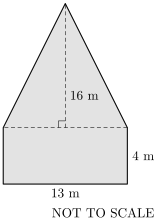
A shape is made from a rectangle with a triangle joined along its top side. The rectangle is 1313 m wide and 44 m high. The base of the triangle is the whole top side of the rectangle. The perpendicular height of the triangle is 1616 m. The diagram shows the shape. What is the total area of the shape?
Figure

Worked solution

The rectangle has area 13×4=5213 \times 4 = 52 m2^2.

The triangle has area 12×13×16=104\tfrac{1}{2} \times 13 \times 16 = 104 m2^2.

The total area is 52+104=15652 + 104 = 156 m2^2.

Answer

156156

Marking guidelines

Adds the area of the rectangle and the area of the triangle

1 mark

Report a problem with this question.

Question 21 markMedium

A trapezium has parallel sides of 6060 mm and 5050 mm. The distance between the parallel sides is 88 cm. Find the area of the trapezium in square centimetres.

Worked solution

Change the parallel sides to centimetres: 6060 mm =6= 6 cm and 5050 mm =5= 5 cm.

Area =12×(6+5)×8= \dfrac{1}{2} \times (6 + 5) \times 8

=44 cm2= 44\ \text{cm}^2

Answer

44 cm244\ \text{cm}^2

Marking guidelines

Converts the units, then uses half the sum of the parallel sides times the distance between them

1 mark

Report a problem with this question.

Not affiliated with NESA.