Year 8 Mathematics

Perimeter of composite shapes

Two worked questions, each with its solution and marking guidelines.

  • Questions at easy, medium and hard levels
  • As short answer and multiple choice
  • Some with diagrams
  • New numbers every time, from 5,000+ templates across NSW Years 7 to 12

Two worked examples

Question 11 markMedium

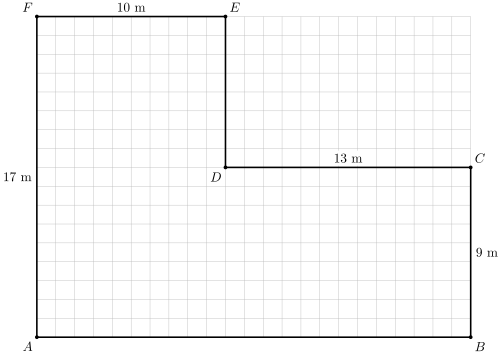
The diagram shows the L-shaped polygon ABCDEFABCDEF, in which every angle is a right angle. BC=9BC = 9 m, CD=13CD = 13 m, EF=10EF = 10 m and FA=17FA = 17 m. What is the perimeter of the polygon, in metres?
Figure

Worked solution

AB=CD+EF=13+10=23AB = CD + EF = 13 + 10 = 23 m

DE=FA−BC=17−9=8DE = FA - BC = 17 - 9 = 8 m

Perimeter=23+9+13+8+10+17=80\text{Perimeter} = 23 + 9 + 13 + 8 + 10 + 17 = 80 m

Answer

8080

Marking guidelines

Finds both hidden edges and adds all six sides to get the perimeter

1 mark

Report a problem with this question.

Question 21 markMedium

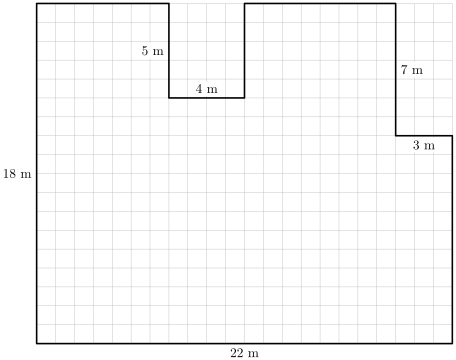
The diagram shows a shape in which every angle is a right angle. It is 2222 m wide and 1818 m tall. The notch in the top edge is 44 m wide and 55 m deep, and the step cut from the top right corner is 33 m wide and 77 m high. Find the perimeter of the shape in metres.

Figure

Worked solution

The top and bottom edges together measure 2×22=442 \times 22 = 44 m, because the notch and the step do not change the total sideways length.

The left and right sides together measure 2×18=362 \times 18 = 36 m, and the two walls of the notch add 2×5=102 \times 5 = 10 m.

Perimeter =44+36+10=90= 44 + 36 + 10 = 90 m.

Answer

9090

Marking guidelines

Adds all the outside edges, including the extra edges of the notch and allowing for the step

1 mark

Report a problem with this question.

Not affiliated with NESA.