
Year 8 Mathematics

Pythagoras' theorem: finding sides and testing for right angles

Two worked questions, each with its solution and marking guidelines.

  • Questions at easy and medium levels
  • As short answer and multiple choice
  • Some with diagrams
  • New numbers every time, from 5,000+ templates across NSW Years 7 to 12

Two worked examples

Question 12 marksMedium

Lucy and Ben lean a plank against the wall of the ferry ticket office. The plank is 2020 m long. The top of the plank touches the wall 1414 m above the ground. The wall is vertical and the ground is flat. The diagram shows the plank against the wall. How far is the foot of the plank from the wall? Give your answer in metres, correct to 2 decimal places.
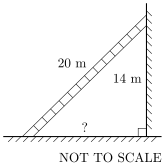
Figure

Worked solution

The plank is the longest side of a right-angled triangle, so the distance dd from the wall satisfies d2+(height)2=(plank)2d^2 + (\text{height})^2 = (\text{plank})^2.

d2=202−142=400−196=204d^2 = 20^2 - 14^2 = 400 - 196 = 204.

d=204≈14.28d = \sqrt{204} \approx 14.28 m.

Answer

14.2814.28

Marking guidelines

Uses Pythagoras with the plank as the longest side

1 mark

Finds the distance correct to the required number of decimal places

1 mark

Report a problem with this question.

Question 21 markMedium

A right-angled triangle has two shorter sides of 1818 cm and 2424 cm. What is the perimeter of the triangle?

Worked solution

The hypotenuse cc satisfies c2=182+242=324+576=900c^2 = 18^2 + 24^2 = 324 + 576 = 900, so c=30c = 30 cm.

The perimeter is 18+24+30=7218 + 24 + 30 = 72 cm.

Answer

7272

Marking guidelines

Finds the hypotenuse and adds the three sides

1 mark

Report a problem with this question.

Not affiliated with NESA.